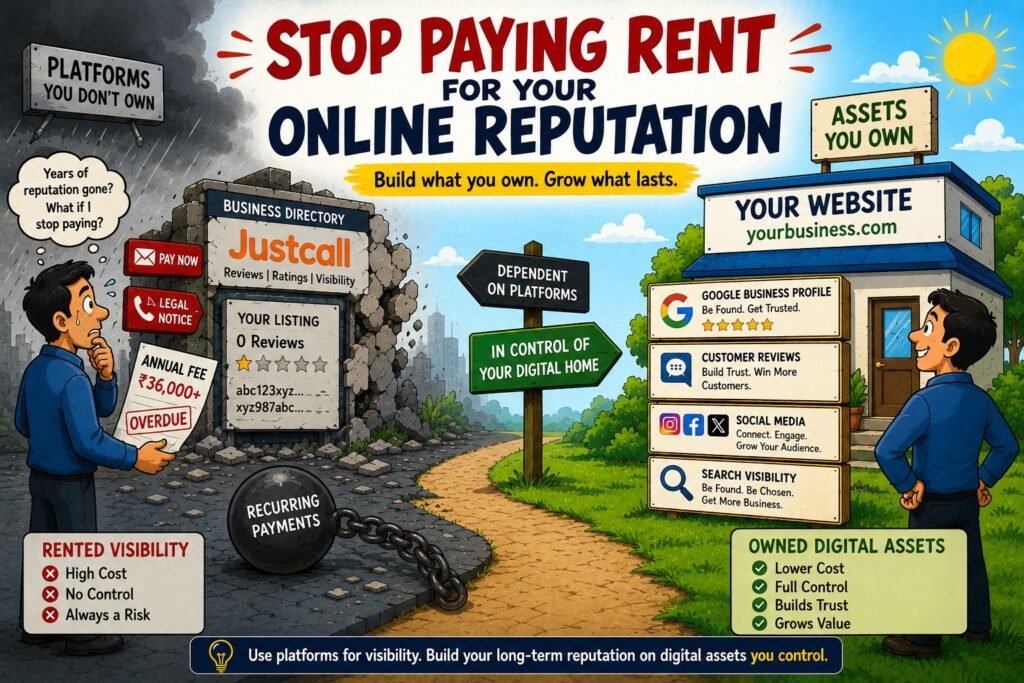
Most businesses don’t realize how much of their reputation lives on a platform they don’t own — until something threatens to take it away.
That’s the risk hiding behind a directory listing, a social media following, or even a “free” Google profile. It feels like your presence. But you’re often just renting space on someone else’s land.
I started noticing this when I began working with the first few clients of Unnati Digi Services GeoRank website. I expected each business to bring its own, unrelated problem.
One would need a website. Another would need Google Business Profile optimization. A third would want better search visibility, or simply a first step onto the internet.
Instead, a pattern kept surfacing.
Most of these businesses had already spent years building a digital reputation. But much of that reputation lived on platforms they didn’t fully control.
For some it was a business directory. For others, social media. The platforms varied — but the underlying worry was the same.
Doctors face the same problem. A reputation built over decades can sit in directory listings and social pages they do not control, which is why experienced doctors still need a website they own.
“What happens to everything I’ve built if I stop paying, if the platform changes, or if I lose visibility?”
That question has become one of the founding ideas behind Unnati Digi Services.
When Reputation Becomes Dependency
Picture running a business for ten years. In that time, you build a name, collect customer feedback, and slowly earn recognition.
Now picture that a large part of that history lives on a third-party platform — one where you’ve paid for premium listings, ads, or subscriptions along the way.
Eventually, a simple business question comes up:
Am I getting enough value for what I’m paying?
Several of our clients have asked themselves exactly that. Some felt the recurring cost of a premium directory listing no longer matched the enquiries it was generating.
But cancelling isn’t simple when a business has spent years building visibility on that platform. The decision stops being about the annual fee.
It becomes about something bigger:
Can I afford to lose the digital presence I’ve spent years building?
One Client’s Experience Made the Problem Real
One of our early clients had lived through exactly this.
He’d paid for a premium directory listing that, in his view, wasn’t generating enough meaningful enquiries to justify the cost. So he cancelled the standing instruction with his bank.
What followed, by his account, was a string of calls and emails. Eventually, he received a legal notice referring to him as a defaulter, with the threat of recovery action.
This is his account of his experience with that provider, and it should be read as such. But it points to a question worth asking regardless of the company involved:
When your business depends heavily on a platform you don’t own, how easy is it to actually walk away?
The Same Fear Shows Up on Social Media
This isn’t limited to local businesses and directories. We see the same anxiety among creative professionals, consultants, and independent businesses who’ve spent years building an audience online.
A photographer builds a following on Instagram over several years. An artist accumulates hundreds of posts showcasing their work. A consultant builds credibility through LinkedIn or X.
For many of them, these platforms aren’t just marketing channels anymore. They represent years of work, an audience, published content, professional recognition, and brand identity.
That’s part of why some professionals keep paying for verification badges or premium subscriptions even when they’re unsure of the return.
I see this up close. Five creators in my neighbourhood currently pay roughly ₹650 a month to Instagram for the blue tick — not because it’s driving measurable growth, but because they’re afraid of losing their content and followers if they don’t.
Meta’s own pricing for this feature in India has shifted since launch — early reports put it at roughly ₹599–₹699 a month depending on platform, with different figures reported at different times. That, on its own, is a small example of how a platform can reprice a feature that once felt like a fixed cost.
When I ask these creators why they pay, the honest answer is rarely “it’s working great for me.” It’s “I’m scared of what happens if I stop.”
Where that fear originally came from is hard to pin down. What’s clear is that the fee is affordable enough that people would rather keep paying it than find out.
The fear usually isn’t about the badge itself. It’s the fear of losing something that took years to build.
Some of that fear is based on rumours about reduced reach after cancelling. Whether every rumour holds up against actual platform policy is a separate question.
What matters is that the fear itself creates dependency. When your reputation lives on someone else’s platform, walking away starts to feel risky no matter what the numbers say.
And the platforms benefit either way.
₹650 a month may seem small.
But multiply it by millions of creators.
Many would rather keep paying than test what happens when they stop.
That adds up to a powerful business model.
One built on uncertainty — not always on proven value.
The Platform Isn’t the Problem
To be clear: the answer isn’t to abandon Google, social media, or directories. That would be neither practical nor sensible.
These platforms provide real value. Google helps customers discover local businesses. Google Reviews offer independent social proof. Social media enables direct communication with an audience. Directories add extra visibility.
A note on Google’s “free” tools. Even services like Google Business Profile, which cost nothing financially, aren’t free in the fullest sense.
You’re still investing time, content, and reputation into a system governed by someone else’s algorithms and policies — one that can shift overnight.
That makes these tools powerful distribution channels, but not a foundation for your business identity. I’d treat them as exactly that: distribution, not ownership.
Why platforms behave this way
Most major digital platforms run on a quarterly, growth-driven business model. Performance gets judged continuously against short-term financial results, engagement metrics, and monetization efficiency. That naturally shapes how features get designed, prioritized, and evolved.
This isn’t a new observation. Writer Chris Anderson mapped out the underlying economics back in 2009, describing how digital businesses can give away the bulk of a product for free while a small share of paying users subsidizes everyone else — the model now generally known as “freemium.”
Google Search, Gmail, and YouTube stay free largely for this reason. Keeping the core service open and accessible drives the scale and network value the business depends on.
At the same time, Google already monetizes the layers above that — Workspace, YouTube Premium, advertising tools for businesses. The pattern is consistent: the foundational service stays free, while convenience, productivity, and promotional features get monetized.
That’s a reasonable basis for believing core access — Google Search, basic Business Profile visibility — will likely stay free for the long term, since its value depends on open, universal participation. Google’s own documentation confirms that creating and listing a Business Profile carries no charge.
But it’s worth being clear-eyed about the rest. Technology writer Cory Doctorow has argued that platforms tend to follow a predictable arc: they start out genuinely useful to users, then gradually shift value toward business customers and advertisers, and finally toward their own shareholders. He termed this pattern “enshittification.”
Not every platform follows this arc, and not every paid feature is a symptom of it. But as platforms optimize for growth, they do tend to introduce new paid layers for enhanced visibility, analytics, or reach.
That doesn’t take away free access. But it can quietly redraw the line between what counts as “basic presence” and what counts as “competitive advantage.” A feature that’s a nice-to-have today can become the price of staying visible tomorrow.
The real risk
The real problem starts when one platform becomes your entire digital foundation.
If your website disappears, you shouldn’t lose your whole reputation with it. If your social reach drops, your business should still have a home online.
If you choose not to renew a directory listing, customers should still be able to find you. No single platform’s policy change should send your digital presence back to zero.
Your Website Should Be Your Digital Home
This is the philosophy behind Unnati Digi Services: build a digital ecosystem where each platform plays a distinct role.
- Your website tells your story — who you are, what you offer, and why customers should choose you.
- Your domain is your permanent, professional address on the internet.
- Google helps customers find you and understand the essentials about your business.
- Reviews give visitors independent proof, beyond what your business claims about itself.
- Social media builds awareness and maintains relationships with your audience.
- Directories add extra discovery as part of a wider visibility strategy.
None of these should be your only digital foundation.
Build an Ecosystem, Not a Dependency
The wrong strategy is putting everything on one platform and hoping it keeps working forever.
A stronger one connects several assets so they reinforce each other:
Your Domain → Your Website → Google Business Profile → Social Media → Relevant Directories
Your Google profile links to your website. Your social profiles direct followers there.
Your website organizes your portfolio and content, creating more opportunities for search visibility — while keeping your brand identity consistent everywhere people encounter it.
Together, this adds up to more than a listing or a profile. It’s a foundation.
Why This Matters to Unnati Digi Services
Our first handful of clients have reinforced this idea again and again.
Most of them didn’t come to us just wanting a website. They wanted a more independent, stable digital presence.
Less dependency on a single directory. A professional home beyond a social media profile. Information they control and can maintain themselves. Something that keeps growing over time, on their terms.
That’s why our work goes beyond website development. We focus on helping:
- Local businesses establish independent online visibility
- Professionals build a credible digital identity
- Creative entrepreneurs showcase and sell their work
- Businesses strengthen their Google presence
- Clients build long-term digital assets instead of depending entirely on rented platforms
The Goal Isn’t to Leave Platforms Behind
It’s to put them in the right place.
Use Google for discovery. Use Google Reviews for independent proof. Use social media for reach. Use directories where they genuinely add value.
But build your core identity on assets you actually own: your domain, your website, your content, your professional identity.
That way, when a platform changes its pricing, algorithm, or policies, you still have a home to stand on.
From Rented Visibility to Owned Digital Assets
We’re not asking businesses to abandon the platforms that help them get discovered.
We’re asking a different question:
What happens if that platform stops being enough?
The answer shouldn’t be panic. It should be that your business already has a foundation of its own.
Use platforms for visibility. Build your long-term reputation on digital assets you control.