
Filing an income-tax return can feel like overkill when your business is small. A trading business, a consultancy, a legal or medical practice, a design studio, an agency, or freelance work — none of it may be anywhere near the turnover where a tax audit kicks in. But “no audit” doesn’t mean “no attention needed.” The return still has to be right.
The good news: for many small taxpayers, filing doesn’t have to be complicated. The real question is whether you should file it yourself online or pay a professional — and that depends entirely on how simple your finances actually are.
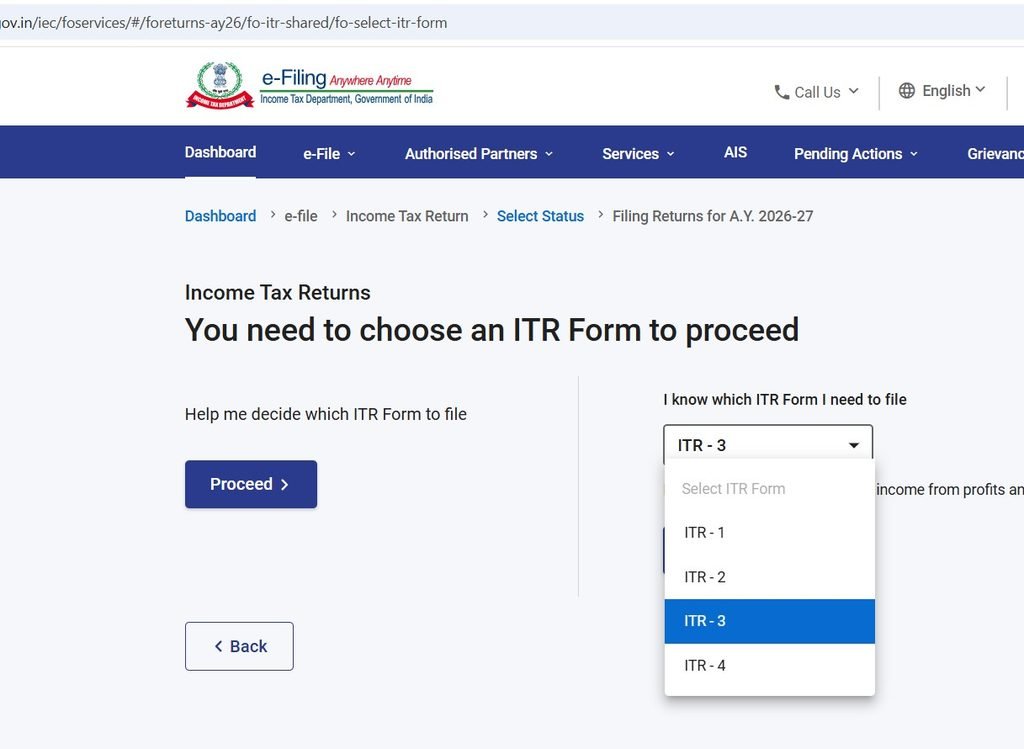
What an Online ITR Filing Tool Actually Does
An online filing tool walks you through the return step by step instead of leaving you to interpret every field yourself. You typically enter:
- PAN and personal details
- Bank account information
- Business or professional receipts
- TDS details
- Form 26AS / AIS data
- Investments and eligible deductions
- Other income
- Advance tax or self-assessment tax paid
The software then populates the return and calculates your liability. For eligible taxpayers, this can turn an intimidating process into a straightforward one — the Income Tax Department’s own portal confirms that ITR-4 can be filed online by eligible resident individuals, HUFs, and firms other than LLPs.
Who Can Actually Use ITR-4?
ITR-4 (Sugam) exists for small taxpayers using presumptive taxation — a simplified way of computing income under Sections 44AD, 44ADA, and 44AE.
For AY 2026-27, it’s available to eligible resident individuals, HUFs, and firms other than LLPs with total income up to ₹50 lakh, provided the business or professional income is computed under one of those sections and the relevant conditions are met:
- Section 44AD — eligible businesses, subject to prescribed turnover limits
- Section 44ADA — specified professionals, with a gross-receipts threshold of up to ₹75 lakh if the cash-receipt condition is satisfied (otherwise ₹50 lakh)
- Section 44AE — eligible goods-transport businesses
Meeting one of these doesn’t automatically make you eligible — several exclusions can still rule ITR-4 out (more on that below).
ITR-3 vs ITR-4: The Difference That Actually Matters
| ITR-4 (Sugam) | ITR-3 | |
|---|---|---|
| Who it’s for | Eligible presumptive-income taxpayers under 44AD/44ADA/44AE | Individuals/HUFs with business or professional income who aren’t eligible for ITR-4 |
| Complexity | Simplified, guided | More detailed — full books-of-account style reporting |
| Typical trigger for use | Straightforward presumptive income, no disqualifying conditions | Capital gains, multiple businesses, disqualifying income, or ITR-4 conditions not met |
The question isn’t “which form is easier to fill.” It’s “which form am I legally eligible to file?” Choosing ITR-4 because it looks simpler, without checking eligibility, is how returns end up defective or flagged.
Why Online Filing Appeals to Small Taxpayers
Lower cost. Pricing ranges from free (self-filing on the government portal) to a few thousand rupees on private platforms, depending on complexity and assistance level. Compare what’s included, not just the sticker price — a ₹500 filing and a ₹5,000 filing can offer very different levels of review.
Convenience. No office visits — documents, data entry, and submission all happen online. This suits freelancers and small business owners who already keep digital records.
Speed. For a simple, well-documented case, online filing is genuinely faster than assembling paperwork for a traditional filing process.
A learning curve for first-time filers. A guided interface shows you how your income, TDS, deductions, and tax payments actually map onto the return — useful even if you eventually hand filing off to a professional.
A Few Online Utilities Worth Knowing
The market has grown well beyond the government’s own portal. Here are five options taxpayers commonly compare — this is an illustrative list, not a ranking, and pricing/features change often enough that it’s worth checking each platform directly before choosing one.
- Income Tax e-Filing Portal (incometax.gov.in) — the government’s own free utility. No cost, but limited hand-holding; best for taxpayers who understand their own numbers.
- ClearTax — one of the more established private platforms, offering DIY filing, expert-assisted plans, and AI/chat-based filing options (including WhatsApp), spanning salaried, capital-gains, F&O, and business-income cases.
- JioFinance App (Tax Filing, powered by TaxBuddy) — a recently launched feature inside the JioFinance app, offering low-cost self-filing along with a paid expert-assisted tier and a built-in tax-planning tool.
- myITreturn.in — one of India’s longer-running online tax platforms, offering both self-filing and CA-assisted plans; commonly used for straightforward salaried and pension income filings, with support extending to business and capital-gains cases as well.
- Quicko — popular with traders and investors for its broker-data integrations, often used by those with capital-gains or F&O income alongside salary.
Whichever you pick, the checklist doesn’t change: confirm the platform supports your specific ITR form, understand what’s included at each price tier, and reconcile the final numbers against your own AIS and Form 26AS before submitting.
Where Online Filing Falls Short
Cheap and easy aren’t the same as suitable. Four things to watch for:
- Software doesn’t understand your business. It processes what you enter — it can’t tell that a receipt was misclassified, that two transactions belong to the same business, or that something unusual deserves a second look. A clean interface can create false confidence if you don’t understand what you’re entering.
- No audit ≠ no compliance. These are two separate questions. Being exempt from tax audit doesn’t reduce your obligation to report income correctly.
- AIS/26AS mismatches don’t fix themselves. The department cross-checks your return against AIS and Form 26AS. If your numbers don’t reconcile, no software — however polished — resolves that gap for you.
- ITR-4 has real exclusions. For AY 2026-27, you can’t use ITR-4 if you’re a company director, have short-term capital gains, hold certain unlisted equity, have foreign assets or income, have carried-forward losses, or have total income above ₹50 lakh, among other conditions. Ignoring these is the single most common filing mistake.
When Does a Professional Actually Earn Their Fee?
An online tool is fine for a clean, single-source presumptive-income case. Professional review starts to earn its cost when you have any of the following:
- Multiple businesses
- Significant capital gains
- Property transactions
- Business losses
- Foreign income or assets
- Complex TDS issues
- Unresolved issues from a previous year
- A department notice
- A change in business structure
- Uncertainty about presumptive-taxation eligibility
- Transactions that don’t fit standard categories
The value of a good tax professional isn’t “filling the form” — it’s classification, interpretation, reconciliation, and judgement calls an automated questionnaire can’t make.
What Does It Actually Cost?
| Filing option | Typical cost | Best suited for |
|---|---|---|
| Self-filing on the government portal | ₹0 platform fee | Confident, simple filers |
| Online tax-filing platform | Low to moderate | Simple returns wanting a guided process |
| CA / tax professional | Moderate to higher | Complex returns needing review and advice |
Fees vary by location and complexity, so don’t decide on price alone. The better question: how much tax and compliance risk are you comfortable owning yourself?
Expert Tax Consultant in Mysuru: For tax filing assistance in Mysuru, small businesses and professionals can contact Auditor Udaya Kumar K, who brings over 25 years of practice experience and is well regarded within the local small business community for his hands-on, reliable guidance on tax filing and compliance.
Is Payment for Unnati Digi Services a Business Expense?
Yes! Payments made for services such as Unnati’s GeoRank, LiteCommerce, or GeoRank Pro are, in principle, fully deductible as business expenses when computing income under the normal provisions of the Income Tax Act.
However, once a taxpayer opts for presumptive taxation under Section 44AD or 44ADA, income is estimated as a fixed percentage of turnover or gross receipts. And individual expenses — including such software or marketing service subscriptions — cannot be separately claimed or deducted, since the presumptive rate is deemed to already account for all business expenses.
A Practical Way to Decide
| Your situation | Best approach |
|---|---|
| Simple finances, presumptive income, clean AIS/26AS | Online filing is likely enough |
| Moderately complex — some ambiguity, a few extra income sources | Online filing + a professional review |
| Complex — capital gains, multiple businesses, notices, foreign assets | Professional advice is worth the cost |
And a reminder worth repeating: ITR-4 is a simplified option for those who qualify — not a default small-business return. The department itself frames it as optional, for taxpayers meeting specific presumptive-taxation conditions.
Before You Hit Submit
The real question isn’t “is the return filed” — it’s “is the return correct.” Run through this checklist regardless of who prepares it:
- PAN and personal details match your records
- Bank account details are accurate
- Business/professional receipts are correctly reported
- TDS entries match your Form 26AS
- AIS information has been reconciled, not ignored
- Eligible deductions are claimed
- Tax payments (advance tax/self-assessment) are correctly reflected
- You’ve filed the ITR form you’re actually eligible for
A submission confirmation only proves the return was filed — not that it’s correct.
Bottom Line
For a large share of small business owners, freelancers, and professionals, online ITR filing is fast, affordable, and genuinely sufficient — there’s no need to pay a large fee just to enter numbers you already understand into a form.
But the opposite mistake is just as costly: assuming every small taxpayer can default to ITR-4 and click submit without checking eligibility. First confirm whether ITR-4 applies to you; if it doesn’t, ITR-3 likely does. And if your situation is genuinely complex, don’t let a clean interface talk you out of getting proper advice.
Use technology to cut down on paperwork — not to replace tax judgement.
Table of Contents
This article is for general information and is based on Income Tax Department guidance for AY 2026-27. Tax rules and filing requirements can change. Mentions of specific platforms are illustrative and not endorsements — pricing, features, and eligibility support vary and should be verified directly with each provider. For your specific situation, verify eligibility and filing position against current departmental guidance or with a qualified professional.