Short answer: If people need to find and visit you, start with Google Business Profile (GBP). If people need to get to know, trust and message you, lean on your Facebook Page. Most local businesses need both, but not equally, and neither replaces a website you own.
Why this question matters
When someone nearby needs a plumber, a bakery or a tailor, they do one of two things: they search (“near me”), or they scroll and get recommended. GBP wins the first moment. Facebook wins the second. Knowing which moment your customers are in tells you where to spend your time.
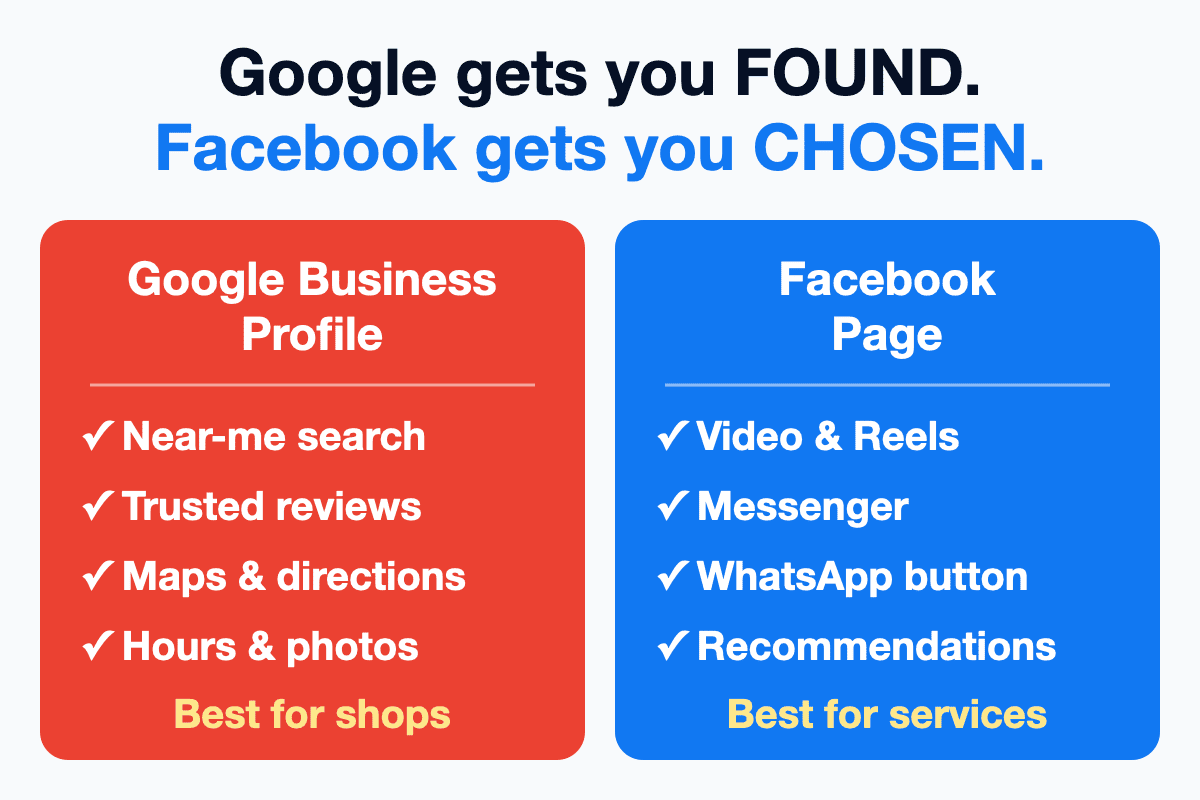
Google Business Profile: built for people who are ready to act
GBP is the free listing that appears in Google Search and Google Maps, including the “map pack” at the top of local results.
What it does best
- “Near me” visibility. Google uses your profile to decide who to show for nearby searches. Industry surveys such as Whitespark’s rank GBP signals as the biggest single factor in local pack rankings (treat exact percentages as directional, since they come from practitioner surveys, not Google).
- Reviews people trust. In BrightLocal’s trust research, Google was the most trusted place to find local business information, ahead of Facebook and Yelp.
- Everything a shopper needs at a glance. Address, directions, hours, phone, photos, videos, product listings and service categories.
- Posts. You can publish updates, offers and events on your profile. This is short-form posting, not a full blog. Your real blog belongs on your website, and the profile can link to it.
- A complete profile builds credibility. Google’s own figure, relayed by BrightLocal, is that customers are 2.7x more likely to consider a business reputable when it has a complete profile.
Where it falls short
- Opening hours matter. For “open now” searches, a closed shop is less likely to be shown, and the listing displays “Closed” to anyone who looks. Keep hours accurate, including holidays.
- Little room for personality. You can’t build a community or a brand story the way you can on a social page.
- Low tolerance for rule-breaking. Fake reviews, keyword-stuffed names and wrong categories can get a profile suspended.
- Small errors cost you. A wrong map pin sends customers to the wrong place. Here is how to fix a wrong Google Maps location in one day.
Best for: shops, restaurants, clinics, salons, gyms, repair centres, anything with a physical location customers travel to. See how we got a 25-year-old Mysuru business listed on Google Maps in 48 hours.
Facebook Page: built for trust, conversation and repeat customers
A Facebook Page is your business’s home on social media.
What it does best
- A mini-studio in one place. Long and short video, Reels, photo albums, live sessions, events and stories, all under one page. It doesn’t replace YouTube or Instagram, but it covers much of what small businesses need from both.
- Direct conversations. Messenger, plus a WhatsApp button, lets a customer go from “interested” to “chatting with you” in one tap. For service businesses that quote prices by message, this is a big advantage.
- Reviews and recommendations. Customers can recommend your business, and friends see those recommendations. This works well for online sellers and service providers who work from home or travel to customers.
- Retargeting and ads. Paid reach on Facebook can be targeted by area, age and interest, and works well for offers and launches.
- Social proof for new visitors. An active page tells people you’re real and still in business.
Where it falls short
- Weak organic reach. Few of your followers see an unpaid post. Don’t build on reach you don’t own.
- Less local-search power. Facebook reviews generally carry less weight than Google reviews, both with Google and with searchers.
- An inactive page hurts. A page last updated two years ago can make a business look closed.
Best for: service providers (tutors, photographers, caterers, beauticians, home repair), online sellers, and businesses that win customers through conversation and visual proof. A good example is how a bridal makeup artist or a videographer can make themselves findable.
Side-by-side
| Google Business Profile | Facebook Page | |
|---|---|---|
| Main strength | Being found when people search | Being trusted and contacted |
| “Near me” search | Excellent | Limited |
| Reviews | Highly trusted, feed local rankings | Good social proof, lower weight |
| Photos and video | Yes, supporting | Yes, a core feature |
| Messaging | Calls and directions (messaging options keep changing) | Messenger and WhatsApp button |
| Content type | Posts, offers, products, services | Posts, video, Reels, events, live |
| Reach without ads | Strong for searchers | Weak |
| Effort | Low: set up once and maintain | Medium to high: ongoing |
| Best for | Walk-in and visit-based | Service and online sellers |
Which should you pick?
- You have a shop people visit: GBP first. Make sure your address, hours, categories, photos and reviews are in great shape. Then keep a simple Facebook Page for offers and community.
- You provide services at customers’ homes or online: Facebook first for showcasing work and chatting, but still set up GBP (as a service-area business, address hidden) so people searching “plumber near me” can find you.
- You sell online: Facebook for discovery and conversation, GBP only if you have a pickup point or showroom.
- Limited time: Spend 70% on the channel where your customers start, and 30% on keeping the other one alive.
The hidden risk: you’re building on rented land
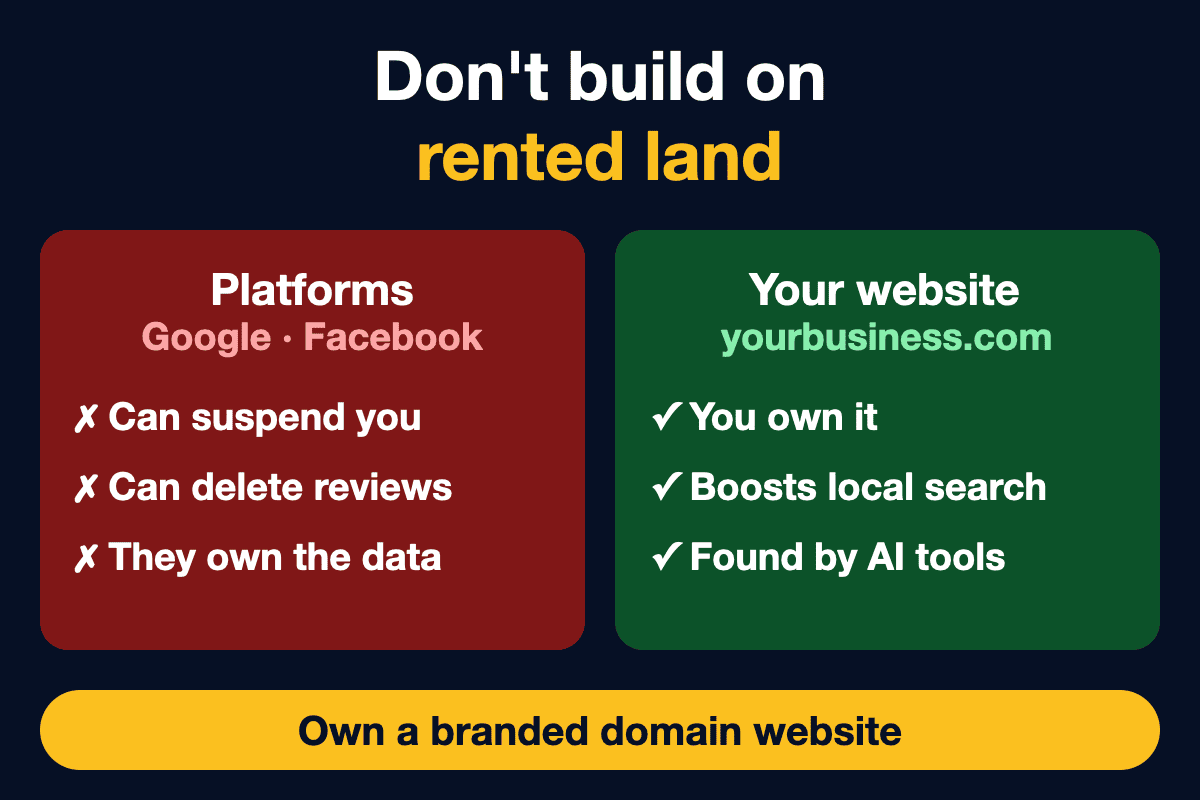
Both GBP and Facebook are platforms you don’t own. That has real consequences:
- They own the relationship. Your followers, your reviews and your customer conversations live inside Google’s and Meta’s systems. You can’t export your reviews or take your audience with you.
- Profiles can be suspended or deleted. A policy violation, a wrongly flagged review, a disputed address change or a compromised login can take your profile offline, sometimes for weeks and sometimes permanently. When it happens, your reviews, photos and ranking disappear with it, and appeals can be slow.
- Free means no real support. Both are free services, and when something goes wrong you pay with your own time. For free accounts, reaching a real person at Google or Meta is very hard, because support leans heavily on bots, algorithms and AI. Most owners are left reading long help guides and vague policies, and an appeal can end in an automated reply.
- The rules keep changing. Features, reach and review policies shift without notice, as the 2026 changes to Google’s Q&A and messaging show.
The fix: own a website on your own branded domain (for example, yourbusiness.com). It is the one asset no platform can switch off.
- It’s your home base. Everything else points to it, and you control the content, the contact forms and a customer email or WhatsApp list. See why a professional website is critical for SEO success.
- It helps local search. Google compares your website with your profile. A site with your name, address, phone, services and location pages backs up what your GBP says and gives Google more to rank you on. Add LocalBusiness schema markup so search engines read your details correctly.
- It’s how you get found by AI. More people now ask ChatGPT, Gemini, Perplexity and Google’s AI answers for local recommendations. These tools draw on websites and trusted sources. In our own test, we looked at how 5 AI chatbots evaluated new websites. A clear site with your services, areas served, FAQs and customer stories gives them something to quote. A business with only a social page gives them very little. Read more on why brands need SEO and AI visibility.
- It’s where your blog lives. Useful articles about your area and services build trust and bring in searches that neither platform can.
Treat GBP and Facebook as storefronts on a busy street, and your website as the building you own.
A simple routine for both
- Match your details everywhere. Same name, address, phone and hours on GBP, Facebook and your website.
- Ask every happy customer for a Google review. Send a direct link by WhatsApp or SMS right after the job. Don’t offer incentives for reviews, and follow Google’s current review policies.
- Reply to every review, good or bad, within a few days.
- Post weekly on both. Reuse the same photo or video with a slightly different caption.
- Add real photos. New ones monthly: your storefront, team, products, finished work.
- Link them. Put your Facebook link on your GBP and your GBP review link on Facebook.
- Publish a blog on your website and share each article on both profiles.
Want to track how you rank locally? See our guide to the best tools for local SEO in Mysuru.
Common mistakes
- Treating Facebook as a replacement for a Google listing
- Leaving the GBP unverified or with wrong hours
- Not responding to messages or reviews
- Posting only discounts, never proof of your work
- Letting either page go quiet for months
- Having no website of your own and depending entirely on platforms that can suspend you
The bottom line
GBP gets you found. Facebook gets you chosen. For a business with a physical location, put GBP first. For a service-led or online business, put Facebook first, but never skip GBP, because someone searching for you at 9pm is ready to buy. And back both with a website on your own domain, because platforms can suspend you and AI assistants look for sites to recommend.
FAQ
Is Facebook or Google better for a local business?
Google Business Profile is better for being found in local and “near me” searches. Facebook is better for conversation, video and building trust with service-based or online businesses.
Do Facebook reviews help local SEO?
They help with social proof, but they generally carry less weight than Google reviews for local search rankings.
Do I need both?
Most local businesses benefit from both, plus their own website. Put the most effort into the platform where your customers start.