
Short answer: Being visible on Google Maps and Facebook helps a business grow, but some women entrepreneurs pay a price for it: strangers use business listings and profiles to send unwanted personal messages. The fault lies with the harasser and with weak platform protections, not with the woman or with digital marketing. Practical steps, such as a separate business number, a hidden address and message filters, can reduce the risk, but platforms must do more.
Online visibility is meant to help women grow their businesses. For some, it has become a reason to hide from the very platforms they depend on.
We tell small businesses to list themselves on Google Maps, create a Google Business Profile, promote on Facebook and be easy to find. For a woman entrepreneur, these are tools of economic independence.
But there is a side of this that gets too little attention. Some women are approached by men who use business listings, social profiles and online marketplaces for reasons that have nothing to do with the business.
This is not a digital marketing problem. It is a problem of harassment, privacy and the misuse of platforms.
Google Maps: a business listing should not become a gateway to harassment
A woman starts a local business and creates a Google Business Profile so customers can find her. A man finds the listing, visits the shop as a customer, collects her phone number, and later sends personal or flirtatious messages.
A number meant for customer enquiries becomes a channel for personal intrusion.
I know this problem first-hand. I built an online shopping cart website for a woman entrepreneur who had faced unwanted attention through both her Google Business Profile and her Facebook account. It is not an abstract issue for me, but something I met while helping a real business grow online.
Some women in this position choose to close their listings. Others switch to a Service Area Business so their address is no longer shown. The irony is hard to miss. A woman invests in her business and her reputation, and then has to reduce her visibility because some people cannot respect professional boundaries.
When hiding the address backfires
In this case, there was a second problem. After her listing was changed to a Service Area Business, it disappeared from Google. Today it does not appear even when someone searches her exact brand name. Business Profile shows no error, and Google Search Console reports no manual action. Her earlier website, which sat on a subdomain, had also dropped out of Google’s index.
I cannot say what caused either problem, and the two may be unrelated. Google gave no reason, and there was nothing to appeal. That is the point. A woman who tried to protect herself by hiding her address was left with no listing, no explanation and no one to ask. Changes to a listing’s address or type can trigger a fresh review, and a mistaken suspension is not unknown, so take screenshots before you change anything, and change one thing at a time.
Facebook: business promotion that comes with unwanted attention
Many women run home-based businesses: food, design, crafts, tailoring, consulting. They often promote through their personal Facebook profiles, because that is where their network is.
That can bring unwanted friend requests, followers and persistent private messages. The difference between a business enquiry and a personal approach is not hard to see. Yet women are usually left to manage the fallout themselves: block, restrict, ignore, or stop promoting.
There is a real trade-off here. In the case I worked on, we set up a Facebook Page for the business, but the Page still has to build its brand, and that takes time. Promoting under a personal name is faster, because a real person’s face and name add instant credibility and trust. The same openness also attracts a large number of dubious followers and requests. A new Page starts with no credibility, while a personal profile brings trust and risk together.
A women-only marketplace and its identity problem
One example is Dhruti Market*, a Facebook marketplace group for women entrepreneurs and the buyers who support them, with about 50,900 members at the time of the screenshot.
I understand the group was once open to the public. After concerns about inappropriate male participation, the administrators made it private and barred men. But a gender rule is hard to enforce online. Some people reportedly join using fake female profiles.
That leaves administrators with a hard question: how do you keep a women-only space when you cannot reliably confirm who is behind a profile? The burden falls on the women who sell and the volunteers who moderate, when the energy should go into helping women sell.
The visibility paradox
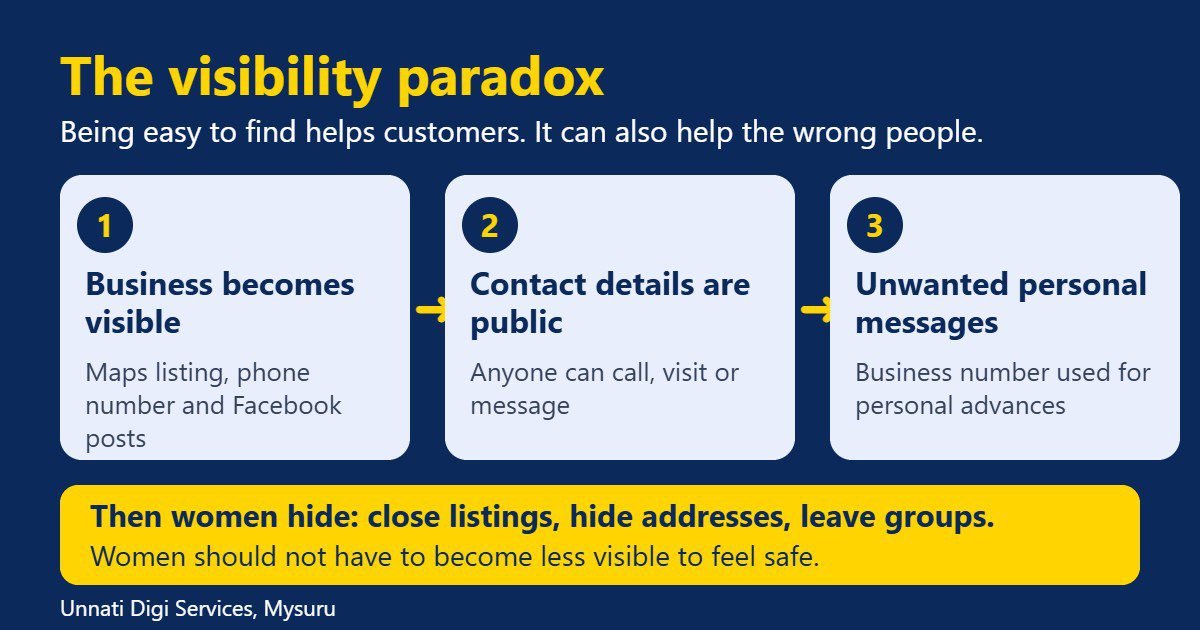
Marketers, local SEO professionals included, say the same things to every business: be discoverable, build a website, engage with customers, grow your audience.
But for some women, the more visible the business becomes, the more they must work to protect their privacy. They hide contact details, restrict profiles, close listings or leave online communities. These are not business decisions. They are defensive ones.
Women should not have to become less visible to feel safe running a business.
What women entrepreneurs can do now
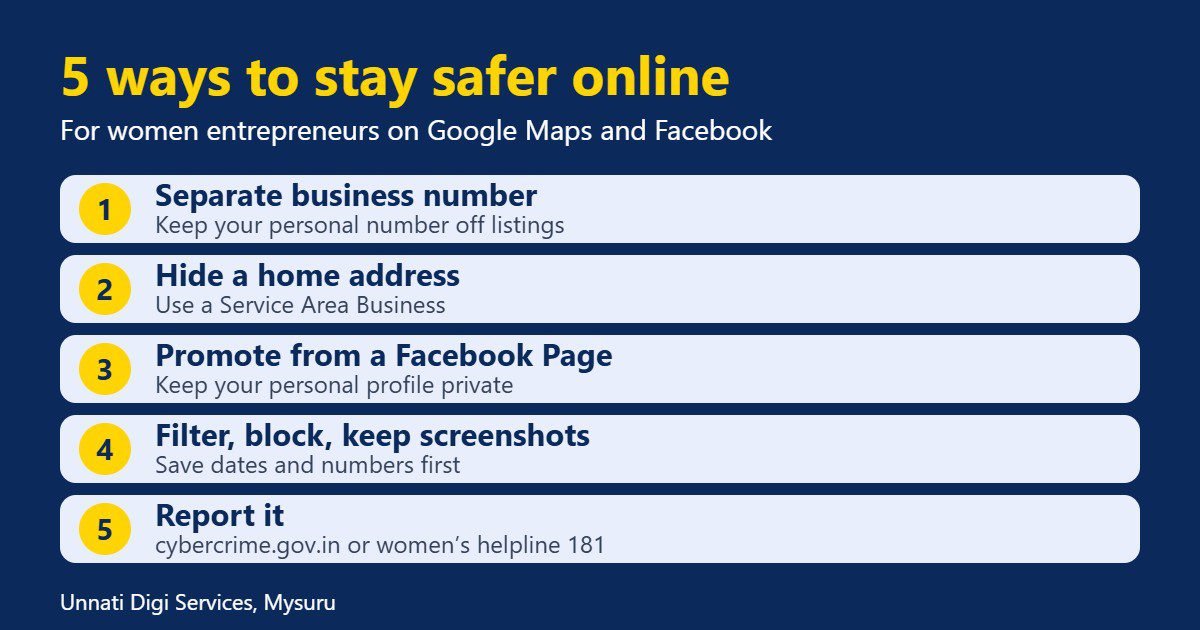
These steps do not remove the problem, but they reduce exposure:
- Use a separate business number. Keep your personal number off your listing and website. A dedicated SIM or a business WhatsApp number works. You can mute or filter it without losing your personal line.
- Hide your home address if you work from home. In Google Business Profile you can set the business as a Service Area Business, so the address is not shown to the public. Our Google Business Profile checklist covers the setup.
- Promote from a Facebook Page, not a personal profile. Keep your personal account private and let customers message the Page. Our guide to Facebook Page vs Google Business Profile explains which one to lead with.
- Borrow trust without opening your profile. A Page feels credible when it shows a real person and real work. Add a short “meet the maker” post, genuine product photos, customer reviews, your city and a story about how the business started. Share Page posts to your personal profile only with a limited audience, such as Friends, not Public.
- Turn on message filters. On WhatsApp Business use greeting and away messages, and block and report repeat senders. On Facebook, limit who can send you friend requests and messages.
- Keep records. Take screenshots of messages, with dates and numbers, before you block anyone.
- Report it. Use the platform’s report tools first. For harassment, you can also file a complaint at the National Cyber Crime Reporting Portal (cybercrime.gov.in) or call the women’s helpline on 181. Persistent unwanted messages can fall under stalking and harassment provisions of Indian law, so do not treat them as “just flirting”.
- Ask for help setting it up. If you are not sure how to separate your personal and business details, ask someone you trust to set it up with you.
Ride apps rate both sides. Maps and Facebook rate only one.
Uber and Ola
Both sides rate each other. A driver can flag a rider who was abusive or drunk, and bad behaviour has a cost.
Google and Facebook
One direction only. Google asks Maps users about parking, unisex toilets and nursing rooms, but never asks the owner whether a customer behaved appropriately, was drunk or harassed anyone. A business can be reviewed, but cannot give feedback about the people who contact it.
So one side is accountable and the other is not. A private channel would be enough, because it need not be a public rating. If owners could report a caller, a visitor or a message sender, privately to Google or Meta, the platforms would have the signal they need to act on repeat offenders.
What Google and Meta should do
Google and Meta run platforms that are essential to the small-business economy. They also carry a responsibility to make them safer.
For Google Business Profile:
- A private way for owners to report a customer’s or caller’s conduct, not only reviews, as ride apps already allow
- Better ways to separate business enquiries from personal contact
- More effective reporting of misuse of business contact details
- Stronger privacy controls for owners facing unwanted attention
- Real, human support for legitimate businesses protecting an owner’s privacy
For Facebook:
- Stronger tools against unwanted personal messages and friend requests
- Better detection of fake or deceptive accounts in women-only communities
- More effective moderation tools for group administrators
- More control for women who use personal profiles to promote a business
None of this ends harassment, but it would reduce the load on women who now manage it largely alone. And as small businesses know, reaching a real person at either company when something goes wrong is very hard.
A business number is not a personal invitation
Sharing a business number
She is inviting enquiries about her products or services. She is not inviting personal advances.
Welcoming customers to her shop
She is offering a professional service. She is not agreeing to personal attention.
Promoting on Facebook
She is taking part in commerce. She is not opening her personal life to strangers.
Some dismiss flirting as harmless. When it is unwanted and persistent, and gets in the way of her work, it is not harmless.
Digital independence must include digital safety
We celebrate women’s entrepreneurship as a route to financial independence. But independence means little if a woman must give up visibility, privacy or peace of mind to sell online.
A woman should be able to run a bakery, boutique, home business or practice without worrying that her online presence will be used for unwanted personal contact.
The answer is not to tell women to avoid Google Maps or Facebook. It is to make the platforms safer, strengthen privacy protections and insist on respect for professional boundaries. The responsibility should not rest on women to hide, block or withdraw.
Digital visibility should empower women entrepreneurs, not expose them to harassment. This conversation deserves to reach beyond women-only communities: to platforms, business associations, local marketers and everyone who wants women to take part in the digital economy with dignity and safety.
Common questions
Can a woman hide her home address on Google Maps?
Yes. If you serve customers at their location or by delivery, you can set up your Business Profile as a Service Area Business and hide the address. If customers visit you, the address must stay visible.
Should a woman entrepreneur use her personal phone number for her business?
It is safer not to. Use a separate business number for listings, your website and WhatsApp, so personal contact and customer enquiries stay apart.
What can I do about unwanted messages through my business profile?
Do not engage. Screenshot the messages, block the sender, report the account to the platform, and file a complaint at cybercrime.gov.in if it continues.
Is a Facebook Page safer than a personal profile for business?
Generally yes. A Page keeps your personal account and friends list separate and lets you control who can message the business. The trade-off is that a new Page has less instant trust than a personal profile, so build it up with real photos, reviews and a short story about the maker.
* Dhruti Market is the short name used in this post for the Facebook group Dhruti Mahila Marukatte, which also appears on Facebook as Dhruti Mart. The member count is as shown on the group page at the time of writing.