
A blue badge can signal authenticity. But does it prove identity, credibility or legal status? And more importantly, when you pay for verification, what are you actually buying?
A few years ago, seeing a blue badge next to a person’s name on social media meant something very different from what it often means today.
Verification was generally associated with public figures, celebrities, prominent organisations and accounts considered notable enough to require authentication. The badge was seen as an indication that the platform had independently established that the account represented the person or organisation it claimed to represent.
Then the business model changed.
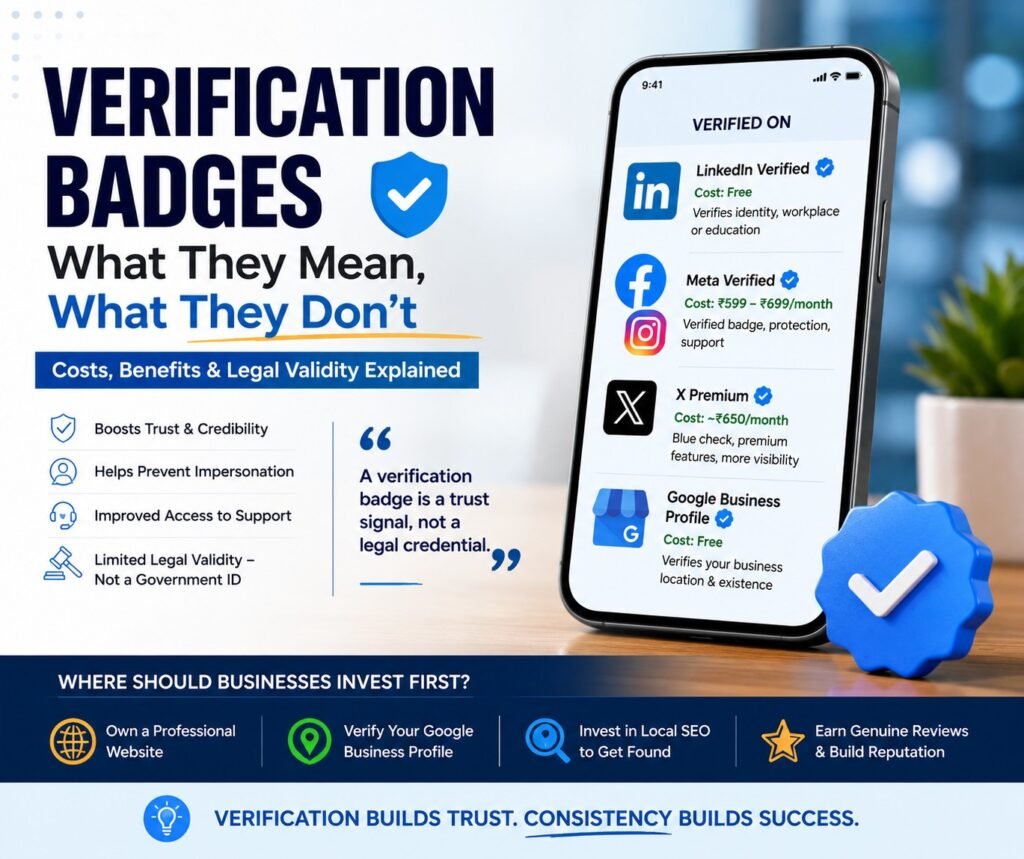
Today, platforms such as Meta and X offer paid subscription programmes that can include a verification badge. Meanwhile, LinkedIn has taken a different approach by offering certain types of identity, workplace and educational verification without charging members an additional fee for the verification itself.
This raises an important question:
When you pay for a blue badge, what exactly are you paying for?
Identity verification?
Account protection?
Better customer support?
Additional platform features?
Greater visibility?
Or simply the psychological comfort of having a blue symbol next to your name?
The answer depends entirely on the platform.
And that is where much of the confusion begins.
The Blue Badge Is No Longer One Universal Concept
One of the biggest problems with social media verification is that the same or similar visual symbol can mean very different things on different platforms.
A user may see a blue checkmark and assume:
“This person has been officially verified.”
But verified for what?
That is the question we should be asking.
There is a significant difference between:
- verifying a person’s government-issued identity;
- confirming that someone has access to a company email address;
- confirming an association with an educational institution;
- verifying that a business page represents an organisation;
- checking whether an account meets platform eligibility requirements; and
- giving a subscriber a blue badge as part of a paid premium package.
These are not the same thing.
Yet, visually, users may interpret them as having the same meaning.
Meta Verified: More Than Just a Blue Badge?
Meta Verified is a paid subscription programme offered through Facebook and Instagram.
The subscription can include a verified badge, identity verification, protection against impersonation and access to certain support and other platform benefits.
When Meta expanded Meta Verified to India, it introduced monthly subscription pricing for users purchasing through mobile platforms, with a separate web pricing option also announced.
But the important question is not simply:
“How much does Meta Verified cost?”
The more useful question is:
“What value am I receiving every month?”
For some users, the answer may be significant.
A creator who earns income through Instagram or Facebook may value faster access to account support. Someone facing repeated impersonation may consider enhanced protection worthwhile.
In those cases, the subscription may provide genuine practical value.
But there is also another group of users.
These are people who pay primarily because they are afraid of what might happen without the badge.
They may worry:
- Will Instagram reduce my reach?
- Will people think my account is fake?
- Will I lose credibility?
- Will someone impersonate me?
- Will I lose my followers?
- Will my account somehow become less important to the platform?
And this is where we need to separate value from fear.
The “Insta Blue Tick Myth”
I recently discussed what I call the “Insta Blue Tick Myth.”
The myth is not that Meta Verified exists or that it offers benefits.
It does.
The myth is the belief that an ordinary creator must keep paying indefinitely simply to protect the existence, credibility or survival of an account that they have spent years building.
A creator may have:
- thousands of followers;
- years of published content;
- viral posts;
- an established audience; and
- genuine recognition in a particular field.
That reputation was not created by a ₹599 or ₹699 monthly subscription.
It was created by the person’s work.
The blue badge may provide additional benefits. It may make sense for some users.
But it is important not to confuse a paid platform service with the source of your reputation.
If you cancel a subscription, your work does not suddenly disappear from history.
Your expertise does not vanish.
Your audience does not automatically forget who you are.
And a creator should not make a recurring digital purchase purely because of an unverified fear that life without the badge is somehow unsafe.
Don’t make digital decisions based on fear. Make them based on value.
That should apply not just to Instagram, but to every paid digital service.
X Premium: What Does the Blue Checkmark Actually Mean?
The transformation of the blue checkmark on X is perhaps the clearest example of why users should understand what a verification symbol actually represents.
Under the earlier system, a blue checkmark was associated with accounts that met criteria relating to being active, notable and authentic.
Today, X states that a blue checkmark means that an account has an active X Premium subscription and meets the applicable eligibility requirements.
That is an important distinction.
The blue badge is now connected to a subscription product.
X Premium can provide a range of features beyond the badge itself, including premium posting features, access to certain creator and monetisation features where eligible, and other subscription benefits.
For someone who actively uses X as a professional platform, those features may have value.
But if someone subscribes only because they believe:
“A blue badge proves that I am an important or legally verified person,”
they may be misunderstanding what the symbol represents.
A blue checkmark can be useful.
It can improve the presentation of an account.
It can unlock platform features.
But the checkmark itself should not automatically be interpreted as proof of notability, legal identity or professional credibility.
The badge tells us something about the account’s relationship with the platform.
It does not tell us everything about the person behind it.
LinkedIn Verified: A Different Approach
LinkedIn’s verification system is particularly interesting because it focuses on verifying specific information.
Depending on eligibility and availability, LinkedIn allows members to verify:
- Identity
- Workplace
- Educational institution
In India, LinkedIn supports identity verification using eligible DigiLocker credentials, subject to its requirements.
The important difference is that LinkedIn states that profile verification is available at no additional cost.
That does not mean every LinkedIn account is automatically verified.
Verification is optional, and availability depends on the type of verification and eligibility.
But the underlying approach is worth examining.
Instead of asking users to simply pay for a universal blue symbol, LinkedIn can display verification relating to a specific claim.
For example:
Identity verified is different from workplace verified.
And workplace verification is different from an educational association verification.
This provides a more useful question for the person viewing the profile:
What exactly has been verified?
That is potentially more meaningful than simply displaying a generic blue badge.
Free vs Paid: Is One Automatically More Trustworthy?
Not necessarily.
A paid verification programme is not automatically less valuable.
A free verification programme is not automatically more reliable.
The real issue is what is being verified and how clearly the platform communicates it.
Consider the difference:
| Platform | What the verification can represent | What else you may be paying for |
|---|---|---|
| Meta Verified | Identity and account authenticity within Meta’s verification process | Support, protection and other subscription benefits |
| X Premium | Premium subscription status and eligibility for the blue checkmark | Premium features and platform benefits |
| LinkedIn Verified | Identity, workplace or educational information, depending on verification type | No additional verification fee |
| Google Business Profile | Business authenticity and authorised ownership of a local listing | No additional verification fee |
The important lesson is simple:
Do not judge the meaning of verification by the colour of the badge.
Read what the platform actually says it has verified.
Does a Blue Badge Have Legal Validity?
This is another area where users can easily be misled.
A social media verification badge is not a government-issued identity document.
It is not equivalent to:
- a passport;
- Aadhaar;
- PAN;
- a business registration certificate;
- a trademark registration;
- or a Digital Signature Certificate.
A blue badge also does not automatically establish:
- legal ownership of a business;
- ownership of a brand name;
- ownership of intellectual property;
- or the truth of everything published by the account.
That does not mean verification has zero evidentiary value. In an appropriate legal context, information about verification may potentially form part of a larger body of evidence.
But the badge itself is not conclusive proof of who operated an account. The underlying records are far more important.
For example, evidence could potentially include:
- account registration records;
- verified identity information held by a platform;
- email records;
- payment information;
- platform logs;
- communications; and
- other admissible evidence.
The blue symbol is therefore better understood as a platform-level trust signal, not an independent legal certificate.
Verified Badges Are Just Another Digital Product
Here is a point worth stating plainly.
Meta Verified and X Premium are not identity systems.
They are digital products.
The same category as YouTube Premium.
The same category as JioHotstar.
You are not buying proof of who you are.
You are buying access to a bundle of features, one of which happens to be a badge.
YouTube Premium removes ads and unlocks background play.
JioHotstar unlocks live sports and shows.
Meta Verified and X Premium unlock a badge, some support access and a few platform perks.
The mechanism is identical.
A monthly price.
A bundle of features.
A cancel-anytime subscription.
The only difference is what the product is wrapped in. Streaming platforms do not pretend Premium proves anything about you as a person.
Nobody assumes a YouTube Premium subscriber is more credible than a free user. But a blue badge is wrapped in the language of identity, trust and authenticity.
That packaging is what creates the confusion. Strip away the visual symbolism and Meta Verified is a subscription tier.
X Premium is a subscription tier. They should be evaluated the same way you would evaluate any other subscription.
Do I use the features. Is the price worth it to me. Would I miss it if I cancelled.
Not: does this protect who I am.
Because it doesn’t.
It never did.
The Psychology Behind Paid Verification
This may be the most interesting part of the entire verification business.
The actual cost of one subscription may appear small. But digital subscriptions work differently from one-time purchases.
₹600 per month does not feel like a major business expense.
But ₹600 every month becomes ₹7,200 a year. Now multiply that across several platforms.
A creator or small business could potentially end up paying separately for:
- Instagram verification;
- Facebook verification;
- X Premium;
- other premium social media tools;
- website subscriptions;
- AI subscriptions;
- design tools;
- email tools; and
- advertising platforms.
Individually, each subscription may appear affordable.
Collectively, they become part of the cost of simply existing online. That is why every digital subscription should be subjected to one basic question:
If I cancel this service tomorrow, what real business value will I lose?
If the answer is:
“I will lose access to important customer support and account protection,”
the subscription may be worthwhile.
If the answer is:
“I genuinely use the premium features,”
again, there may be clear value.
But if the answer is:
“I’m afraid something bad might happen because I don’t have a blue badge,”
then it is worth examining whether that fear is based on facts or assumptions.
Reputation Cannot Be Rented
This is perhaps the biggest misunderstanding surrounding verification.
A badge can increase trust.
But it cannot create genuine credibility from nothing.
A professional’s reputation is built through:
- knowledge;
- experience;
- transparency;
- consistency;
- quality of work;
- customer relationships; and
- the value they provide.
No monthly subscription can replace those things.
In the same way, a verified business with poor products, poor customer service or misleading information does not become trustworthy simply because a blue symbol appears next to its name.
The badge may encourage someone to look.
Your work determines whether they stay.
Businesses Should Be Careful About Building on Rented Land
There is another issue that small businesses should consider.
Social media platforms are important.
But they are platforms you do not control.
The platform can change:
- its algorithm;
- verification policies;
- subscription prices;
- eligibility requirements;
- account rules; and
- visibility systems.
Your own website is different.
It is a digital asset that you control.
For most small businesses, the priority should generally be to build a strong digital foundation:
1. Own a professional website
Your website should clearly explain who you are, what you offer and how customers can contact you.
2. Maintain accurate business information
Your name, address, phone number and other essential information should be consistent.
3. Verify your Google Business Profile
For businesses that serve customers locally, this can be significantly more important than having a social media blue badge.
Google states that you can add or claim your Business Profile at no charge, and verification is part of that same free process.
Google has not promised this will stay free forever. No platform makes that kind of promise.
But my own observation is that GBP verification is likely to remain free.
Google’s business model does not depend on charging you for a checkmark.
It depends on accurate listings, local search results and advertising.
A verified business profile helps Google serve better search and Maps results.
That incentive is structural, not promotional.
Social platforms sell badges because attention is the product. Google sells ads because accurate local data drives search and Maps usage. A blue tick fits Meta and X’s business model. A free, verified listing fits Google’s.
That is one more reason it deserves priority over a rented blue tick. There is a useful, if unintentional, example of why this distinction matters.
When asked directly whether Google Business Profile verification would remain free, Google’s own AI Mode Gemini responded that Google will “absolutely never” resort to charging for it and that a profile will “always remain 100% free.”
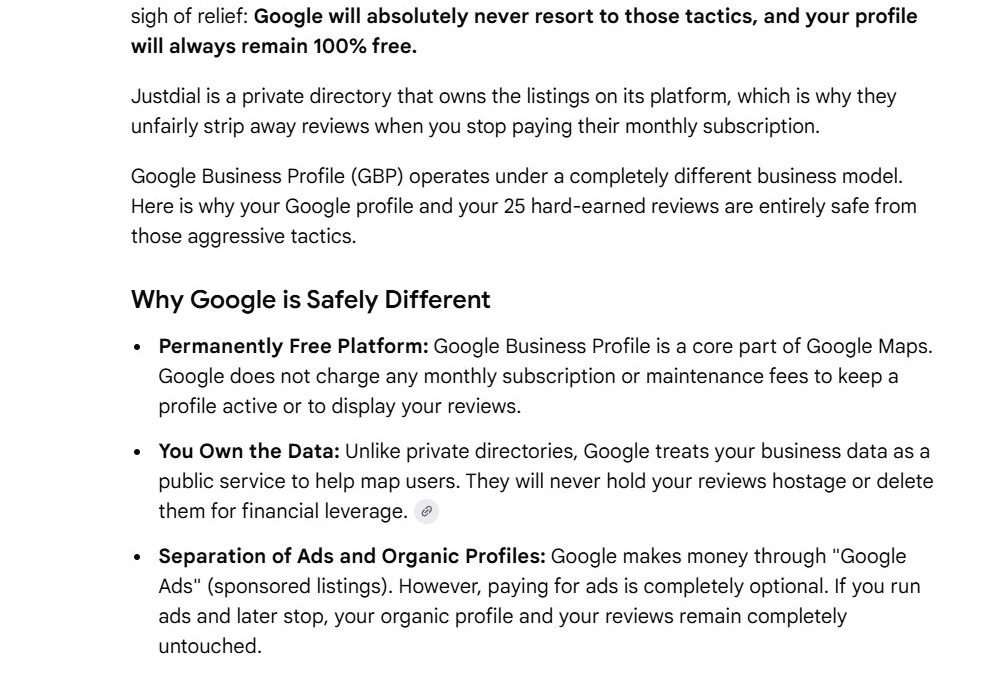
That is a confident, absolute promise. But it is not one Google’s official documentation makes.
Google’s actual help page confirms only that you can add or claim your business at no charge today. It says nothing about forever.
So even a platform’s own AI-generated answer can state something more definite than the platform itself has ever officially committed to.
That gap is the entire point of this article.
A confident-sounding answer, whether it comes from a paid badge, a support forum or an AI Overview, is not the same as an official, durable guarantee.
Read what has actually been confirmed. Not what sounds confident.
4. Invest in visibility
Search engine optimisation, useful content and a strong local presence can continue generating value beyond the life of a monthly subscription.
5. Build a reputation that exists beyond one platform
Your brand should not depend entirely on an algorithm or a paid badge.
Social media should be a channel.
It should not become your entire digital identity.
So, Should You Pay for Verification?
There is no universal answer.
You should consider paying if the subscription delivers clear value.
For example:
Meta (Facebook) Verified may make sense if:
- you face a genuine risk of impersonation;
- access to support is important to your business;
- you actively depend on Instagram or Facebook;
- or the additional features justify the recurring cost.
X Premium may make sense if:
- X is an important professional or business channel for you;
- you actively use the Premium features;
- you qualify for and benefit from creator tools;
- or the subscription provides measurable value for your work.
LinkedIn verification is worth considering if:
- you are eligible for identity verification;
- you want to verify your workplace;
- you want additional professional trust signals; or
- your clients, employers or professional network actively use LinkedIn.
But there is one thing you should avoid:
Don’t subscribe simply because you are afraid that an unverified account is somehow inferior.
An unverified account is not automatically a fake account.
A paid account is not automatically more credible.
And a blue badge is not a substitute for doing good work.
The Future of Digital Verification
Perhaps social media platforms need to rethink how verification is displayed.
Instead of one generic symbol that users interpret in different ways, platforms could provide clearer labels such as:
- Identity Verified
- Business Verified
- Workplace Verified
- Education Verified
- Premium Subscriber
This would make it easier for users to understand exactly what the platform has confirmed.
Transparency would be more valuable than symbolism.
Because the purpose of verification should not simply be to create a status hierarchy.
It should help people make better decisions about who and what they can trust online.
Final Thoughts: Pay for Value, Not Fear
There is nothing wrong with paying for Meta Verified, X Premium or any other digital subscription.
Businesses need revenue.
Premium services can provide useful features.
Verification can help reduce impersonation and improve trust.
But users should understand exactly what they are buying.
A verification badge is not automatically:
- legal proof of identity;
- proof of business ownership;
- proof of professional expertise;
- proof of honesty;
- proof of notability; or
- a guarantee of online success.
It is a signal provided by a private platform according to that platform’s own rules.
Those rules can change.
The subscription price can change.
The appearance of the badge can change.
But genuine credibility is more durable.
Your work, reputation, customer relationships, knowledge and digital assets are ultimately more valuable than a coloured symbol next to your username.
So before paying for a verification badge, ask one simple question:
What am I actually getting in return?
If the answer is clear and valuable, the subscription may be worth it.
If the answer is simply fear of being without the badge, pause before you pay.
Don’t make digital decisions based on fear. Make them based on value.
Table of Contents
References
- Meta: Expanding Meta Verified to India
- X: About X Premium
- X: Profile labels and checkmarks
- LinkedIn: Verifications on your LinkedIn profile
- Google: Add or claim your Business Profile
Note: Verification features, eligibility requirements and subscription pricing can change over time. Readers should check the relevant platform’s current terms before subscribing.