
Most businesses worry about conversion rates when they build a website. Advocates have a different first question. Is this even allowed?
Doctors, architects, and chartered accountants can advertise, within limits. Advocates in India cannot. That restriction comes from one specific rule, and it’s being enforced more actively than most people realize.
The Rule Behind All of This
Rule 36, in plain terms
The rule is Rule 36, Chapter II, Part VI of the Bar Council of India Rules. It sits under the Advocates Act, 1961.
It bans advocates from soliciting work. It bans advertising, direct or indirect. That covers circulars, personal communication, touts, and interviews.
A 2008 amendment carved out one exception. An advocate may keep a bare, factual website. The exception is narrower than most people assume.
Enforcement has picked up
In March 2025, the Bar Council of India issued a formal warning. It targeted social media promotion, celebrity endorsements, and influencer marketing.
One example cited was a law firm’s campaign featuring a Bollywood actor. The BCI also flagged banners and stalls at public events, and “legal influencer” content spreading misinformation.
The consequences named were serious: suspension of enrollment, and referral to the Supreme Court for contempt in the worst cases. Platforms were told to set up vetting mechanisms and pull violating content within four weeks.
A Supreme Court case is pending
As of August 2026, a bench led by Chief Justice Surya Kant is hearing a public interest challenge to Rule 36 itself.
The petitioners argue the ban favors already-established senior advocates. Younger lawyers, and those outside major cities, need visibility to build a practice. The Court has asked state bar councils to respond.
Nothing has changed yet. The rule is fully in force today. Build for the rule as it stands, not for a change that hasn’t happened.
Things You Can Say
A compliant website can state:
- Name, office address, and contact details
- Phone number and email address
- Bar council enrollment number
- Educational and professional qualifications
- Areas of practice, described as plain fact
That last one is the trickiest. The rule bans claiming “specialization.” But visitors need to know what kind of work a firm handles.
The safe version is factual: “the firm handles civil and property matters.” The unsafe version asserts superiority: “we specialize in winning property disputes.”
The disclaimer is not optional
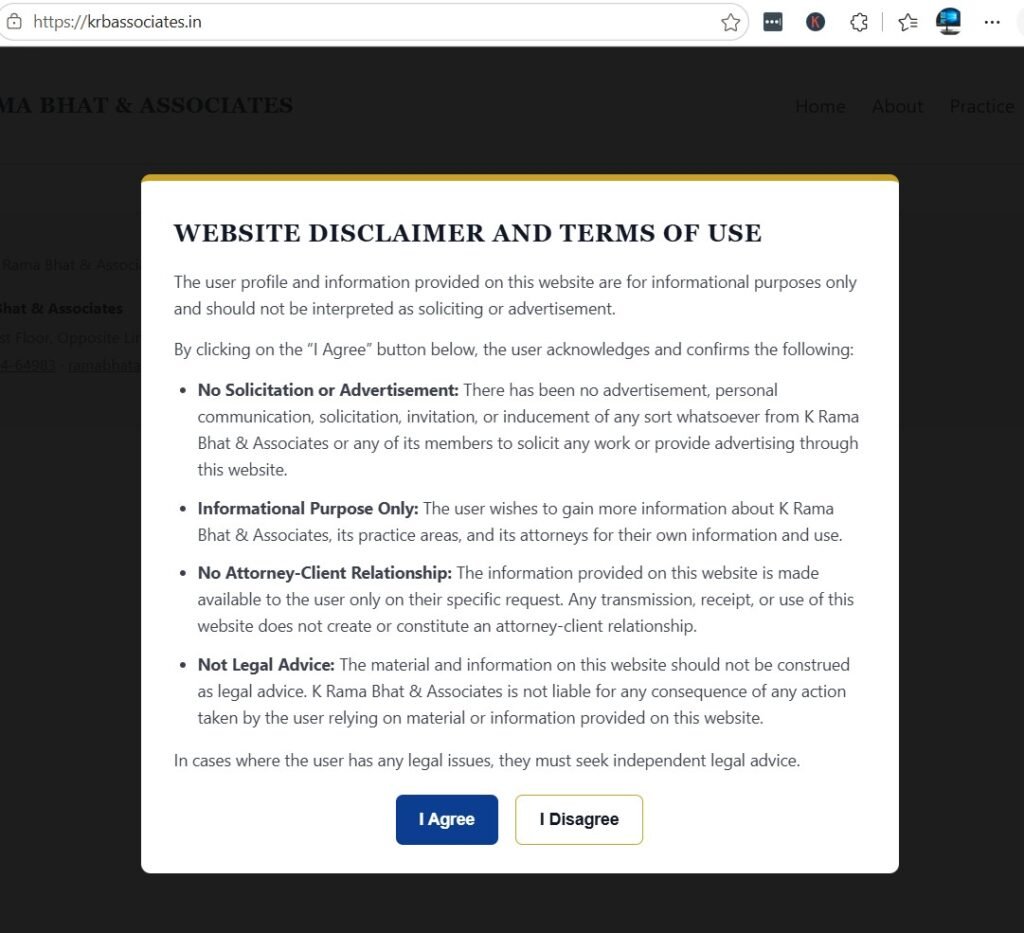
Every such website must carry a disclaimer. It should say the visitor sought this information voluntarily. It should say nothing on the site is advertising or solicitation. It should say viewing it creates no advocate-client relationship.
This is why almost every Indian law firm website shows a click-through page first. A block of disclaimer text, with “I Agree” and “I Disagree” buttons, sits in front of the real content.
That gate isn’t decorative. It’s the legal mechanism that keeps the site “passive.” A visitor has to seek the information out. Nothing gets pushed at them. That distinction is the whole basis for the exception.
Things You Should Not Say
The prohibited list is longer, and enforcement has visibly increased:
- Photographs connected to specific cases or clients
- Client testimonials, reviews, or star ratings of any kind
- Superlative claims — “the best,” “leading,” “top-rated,” “India’s most trusted”
- Case results, win rates, or settlement figures
- Comparisons to other advocates or firms
- Judicial positions or bar office held, framed as a credential-flex rather than plain biography
- Fee information presented promotionally
- Logos or association claims used to imply prestige
Where firms actually get caught
Testimonials are the most common violation. They’re standard practice on almost every other kind of business website, which makes them easy to include out of habit. There’s no safe version of a client quote on an advocate’s site.
Social proof widgets are the newer problem. A star-rating plugin, a review carousel, an “as featured in” bar — these read as advertising even when the underlying words are careful.
A Question Worth Answering: How Is Google Allowing Legal Ads?
Search “lawyer near me” in Bangalore, Delhi or Mumbai and paid ads do show up. That looks like a contradiction. It isn’t quite one, and the reason matters.
Google’s policy puts the burden on the advertiser
Google’s own advertising policy on legal requirements says advertisers must comply “with the local laws and regulations of any area your ads target.” Google doesn’t maintain a bar-council-specific check for India inside its ad review system.
Google Ads does require special certification for a “legal services” category in some countries — the US, for instance, requires Local Services Ads providers to verify state bar status. No equivalent India-specific legal-services certification exists in Google’s public policy today.
So who is actually breaking the rule?
Rule 36 binds advocates. It’s a professional-conduct rule enforced by bar councils, not a law that binds Google as a platform.
When an Indian advocate or firm runs a Google Ad, the advocate is the one at risk of a bar council complaint. Google’s ad review checks its own content policies — misleading claims, prohibited categories — not India’s professional-conduct code for lawyers.
That gap is exactly why digital marketing agencies openly sell “Google Ads for law firms” services in India, and exactly why the BCI’s March 2025 notice asked platforms generally to build better vetting. Enforcement today still runs mainly through bar council complaints against the individual advocate, not through Google blocking the ad upfront.
The practical takeaway: an ad running successfully on Google is not proof it’s compliant with Rule 36. It’s proof Google’s own policies didn’t catch it.
Best Practices for the Actual Build
Make the disclaimer gate robust, not just present
The gate should block all content until a visitor clicks “I Agree.” Use tested, established disclaimer language rather than writing new legal copy from scratch.
Keep the gate’s logic out of anything a content editor could silently strip. Many website editors sanitize embedded scripts on save. If the “I Agree” button’s logic lives inside editable page content, one routine content update can break it without anyone noticing.
Write every sentence as if a disciplinary committee will read it
“We provide guidance across civil, property, and corporate matters” survives scrutiny. “We’re the region’s leading experts in civil litigation” does not.
The difference is entirely in whether the sentence describes the work or asserts it’s better than someone else’s.
Watch what’s outside the website too
A compliant website paired with a five-star Google Business Profile, or a “top-rated” legal directory listing, undercuts the same protection the website observes. The rule is about solicitation as a concept. It isn’t limited to one document called “the website.”
Treat blog content as informational, never promotional
A plain explainer on a recent amendment reads as informational. A post titled “why you need our firm for your GST dispute” reads as solicitation, disclaimer or not.
Revisit the workflow, not just the launch version
A compliant site can drift. Someone adds a new photo. Someone pastes in a review-shaped quote. A stray superlative creeps into a content update. Enforcement doesn’t care whether the drift was intentional.
Quick Compliance Checklist
Before publishing or updating a site, check:
- Does the disclaimer gate block content until an affirmative click?
- Is every practice area described as fact, not specialization?
- Any photograph tied to a specific case or client?
- Any use of “best,” “leading,” “top,” or “India’s most” — anywhere, including image alt text?
- Any testimonial, review widget, or star rating, including ones pulled from a connected platform?
- Any implied case outcome, win rate, or settlement figure?
- Is the enrollment number accurate and current?
- Does the Google Business Profile, directory listing, or social presence match the same standard as the website?
Where This Is Heading
The Supreme Court case is worth watching, not acting on. The petitioners raise a real critique — the rule favors advocates who don’t need advertising.
But the same month this case is being heard, the BCI is actively issuing warnings under the existing rule. Building for a change that hasn’t happened is a bet against the compliance risk sitting in front of you today.
The safer approach is the boring one. A plain, factual, disclaimer-gated site. Update it if and when the rule itself changes — not before.
This article is general information about a professional-conduct rule, not legal advice. A bar council’s own guidance, or a lawyer who advises on professional responsibility matters, is the right source for a specific compliance question.
Table of Contents
Sources
- Bar Council of India Cracks Down on Legal Advertising and Influencer Culture — Gala Law
- BCI Tightens Rules on Lawyers Advertising Online, Issues Warning — MediaNama
- Rule 36 At The Crossroads — India Legal
- Can Lawyers Advertise in India? Rule 36, Bar Council Rules — KSandK
- Bar Council of India Rules on Advertising: The Definitive 2026 Guide — JuriGram
- Legal requirements — Google Advertising Policies Help
- Google Ads Policy for Legal Firms in 2026 — Digital Marketing Knight
Not sure who should build your professional website? Compare the top web designers in Mysore before you hire.
Doctors face similar questions: read why experienced doctors still need a website, and see our website development service.