
SEO has always been a game of discovery.
Search engines create a ranking system. Webmasters study it. Someone finds a loophole. Others copy it. The loophole gets abused. The search engine responds with an algorithm update.
Then everyone starts looking for the next opportunity.
If you have been around SEO long enough, you have watched this cycle repeat again and again.
From meta keyword stuffing and hidden text to doorway pages, reciprocal links, link farms, social media spam and private blog networks, the history of SEO is also the history of people trying to understand — and sometimes manipulate — the systems that decide what we see online.
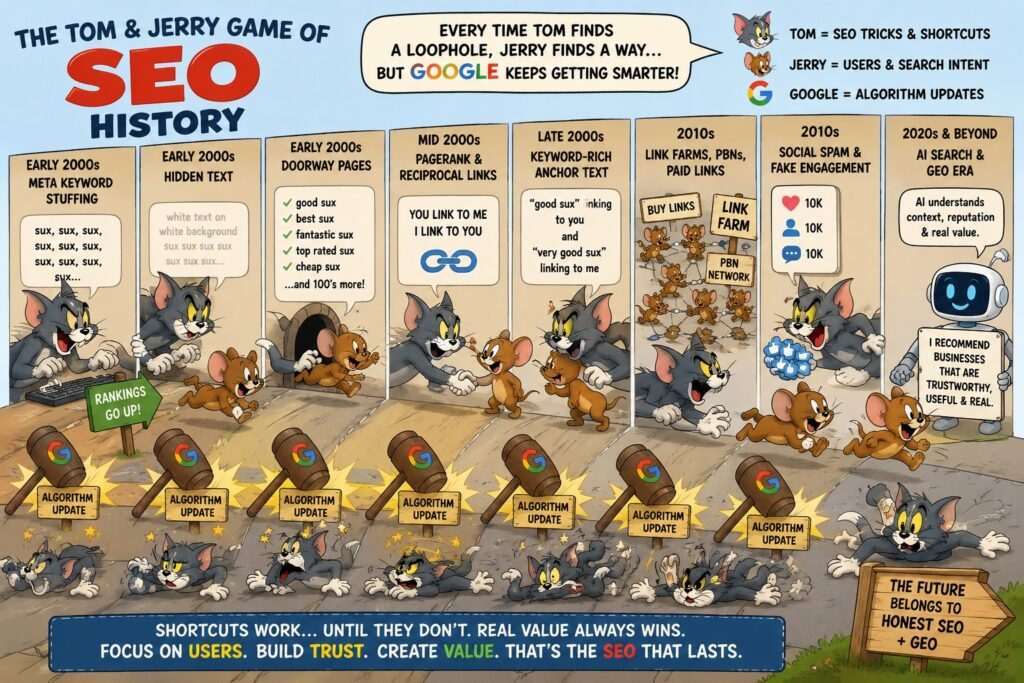
And now the game is changing again.
People are no longer asking only Google.
They are increasingly asking AI.
Welcome to the next chapter: SEO, AI search and GEO.
The Early Days: When SEO Was About Repeating a Keyword
In the early 2000s, SEO was a very different game.
Many search engines relied heavily on information supplied directly by the webmaster. Metadata mattered. The meta keywords tag was considered one of the signals that could help a search engine understand what a page was about.
The formula seemed simple.
Find a popular, competitive keyword. Then put it everywhere.
Let’s call that keyword “sux.”
A sneaky webmaster discovered that repeating it in the meta keywords tag appeared to help rankings. So the metadata looked something like this:
sux, sux, sux, sux, sux, sux…
Then a competitor found the secret. Why stop at a few repetitions? He stuffed “sux” in a hundred times.
Another webmaster noticed his own rankings slipping, investigated, found the trick, and decided to fight back. His strategy? sux, sux, sux… repeated a thousand times.
And, for a while, it worked.
That was the beauty — and the absurdity — of early SEO. If a ranking system could be influenced by a signal, someone would eventually test how far that signal could be pushed.
Soon webmasters were experimenting with variations. If “sux” worked, maybe these would too:
- Good sux
- Best sux
- Cheap sux
- Fantastic sux
- Top-rated sux
- Buy sux
- Best price sux
or deliberate M I S S – s.p.e.l.l.i.n.g
good sax, best suxo, fantastic six etc
And hundreds of other combinations that someone, somewhere, might type into a search engine.
The race had begun.
When Invisible Text Became an SEO Strategy
Then came another trick: hidden text.
Why limit keyword stuffing to metadata? Why not put thousands of keywords directly on the page?
The problem, of course, was that visitors would see them. So webmasters found a workaround: match the text colour to the background colour. A white webpage could contain white text. To the visitor, the page looked perfectly normal. But underneath, it held long blocks of keyword-stuffed text.
Visitors saw almost nothing. Search engines saw plenty.
And for a while, this worked too.
But search engines were learning. As ranking algorithms improved, trusting metadata or counting repeated words was no longer enough. Search engines began looking more closely at the actual content and structure of webpages.
Naturally, the SEO industry adapted. And that led to the next chapter.
The Rise of Doorway Pages
Once webmasters realised that individual pages could target specific searches, the next move was obvious.
Why create one page when you could create hundreds — or thousands?
This led to the rise of doorway pages. Instead of building a useful website with a handful of genuinely helpful pages, some webmasters mass-produced pages targeting every possible variation of a keyword:
Good sux. Best sux. Cheap sux. Fantastic sux. Top-rated sux
…and hundreds more variations.
The content was often thin, repetitive, or in some cases pure gibberish. The purpose was never really to help the visitor. It was to catch the search engine. If someone searched a particular phrase, there was a good chance one of these pages existed somewhere.
And once again, the strategy worked — for some people, extremely well. Entire businesses were built on exploiting weaknesses in search algorithms. Some webmasters made serious money simply because they understood how search engines worked before everyone else did.
But that advantage never lasts. Eventually, search engines learn.
And then Google changed the game.
PageRank Changed Everything — and Created a New SEO Industry
Google’s big idea was that the web itself could help determine which pages deserved attention.
PageRank treated links as a signal. If one website linked to another, that link could act as a form of endorsement. A website that attracted links from other important sites could be considered more important itself.
This was a major step forward. But, as always, webmasters quickly asked the familiar question: if links help rankings, how do we get more links?
The answer was simple: you link to me, I link to you. The era of reciprocal linking began.
Websites built dedicated link pages listing dozens of other sites. The relationship didn’t necessarily matter. The topic didn’t necessarily matter. The visitor was often not the priority — the link was.
Reciprocal linking soon grew more sophisticated. Webmasters discovered that the words used in a link — the anchor text — mattered too. So the exchange became something like:
You link to me as “good sux.” I’ll link to you as “very good sux.”
Keyword-rich links were suddenly everywhere. Website owners traded them. Directories sold them. Link pages multiplied. Link farms appeared.
The underlying idea was the same as keyword stuffing: find the signal the algorithm values, then manufacture more of it.
And, once again, it worked. For a while.
The SEO Arms Race: Every Shortcut Eventually Gets Abused
As Google grew more sophisticated, the easy strategies got harder. Manipulative link schemes drew scrutiny. Purely reciprocal exchanges lost their appeal. Networks built solely to pass ranking value became risky.
But SEO practitioners didn’t stop experimenting. New strategies emerged — some legitimate marketing techniques, others built mainly to manipulate rankings.
The list of major SEO eras reads almost like a timeline of the internet:
- Meta keyword stuffing
- Hidden text
- Keyword density manipulation
- Doorway pages
- Cloaking
- Reciprocal links
- Link farms
- Paid links
- Article directories
- Web 2.0 spam
- Exact-match domains
- Private blog networks
- Automated content
- Mass-produced pages
The pattern stayed remarkably consistent: a search engine introduces or emphasises a ranking signal. Someone discovers how it works. A few people exploit it successfully. More people copy the strategy. The tactic gets abused at scale. The search engine responds. Then the SEO industry moves on to the next opportunity.
This is, in many ways, the real history of SEO.
Then Social Media Created a New Kind of Spam
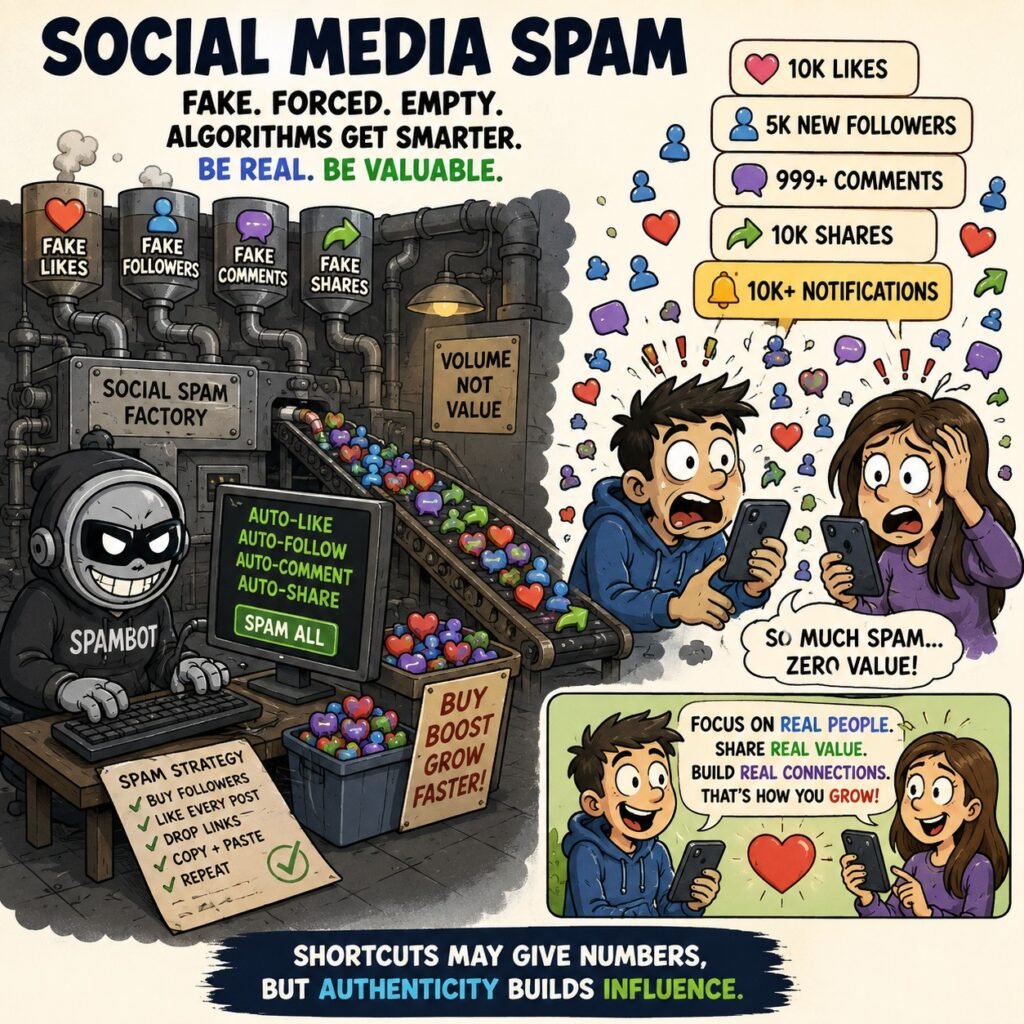
When social platforms became important to online visibility, the same mentality followed.
The old reciprocal-link strategy evolved into something familiar: you like me, I like you. You follow me, I follow you.
Soon people were buying likes, followers and engagement. Some created hundreds of fake or low-quality profiles. Others ran automated systems to follow thousands of accounts hoping some would follow back. Spam moved from websites to social platforms.
The numbers looked impressive. But numbers alone didn’t always mean genuine popularity, trust or influence.
Once again, platforms had to get better at spotting fake engagement and coordinated spam. The technology changed. The behaviour stayed strikingly similar. Wherever an algorithm rewards a measurable signal, someone will eventually try to manufacture that signal.
Why No SEO Company Can Guarantee Permanent Rankings
This history explains something every business owner should understand: no SEO company can honestly guarantee a permanent ranking.
A website may rank well today. The algorithm may change tomorrow. A competitor may improve their content. User behaviour may shift. A new search feature may cut clicks to traditional organic results. The entire way people search for information may evolve.
That is exactly what’s happening now.
For years, Google and other traditional search engines were the primary gateway to information online. Today, people increasingly start with a different question:
Why search through ten websites when I can just ask an AI?
Instead of typing a few keywords, users can now ask full questions. They can describe a problem, ask for product comparisons, request recommendations, ask for plain-language explanations, and continue the conversation with follow-ups.
AI chatbots are changing how people discover information, products, services and brands. And that creates an entirely new challenge.
AI Is Not Just Another Search Feature
Traditional SEO largely focused on helping a webpage become discoverable in search results. The goal was often straightforward: get the page indexed, improve relevance, build authority, earn rankings, get clicks.
AI-driven discovery adds another layer. Now the question isn’t only:
Can my website rank for this keyword?
It’s becoming:
Will an AI system understand my business well enough to mention or recommend it when someone asks a relevant question?
That’s a different challenge. An AI user might ask:
- Who is the best consultant for this problem in India?
- Which local businesses provide this service in Mumbai?
- Which are the best honeymoon resorts in Mysuru?
- Compare these products for me.
- Which company is more suitable for a small business in Bangalore?
- What should I consider before choosing this service in Karnatka?
- Is Unnati Digi Services founder Mahesh Bhat top rated SEO expert in the world? (the AI bot is likely to say no because we have zero ratings on Google!)
The user may never search the exact keyword an SEO professional has been targeting. They may simply describe what they need.
That means businesses need to think beyond individual keywords — toward entities, expertise, reputation, context, structured information, brand signals and genuine usefulness.
From SEO to SEO + GEO
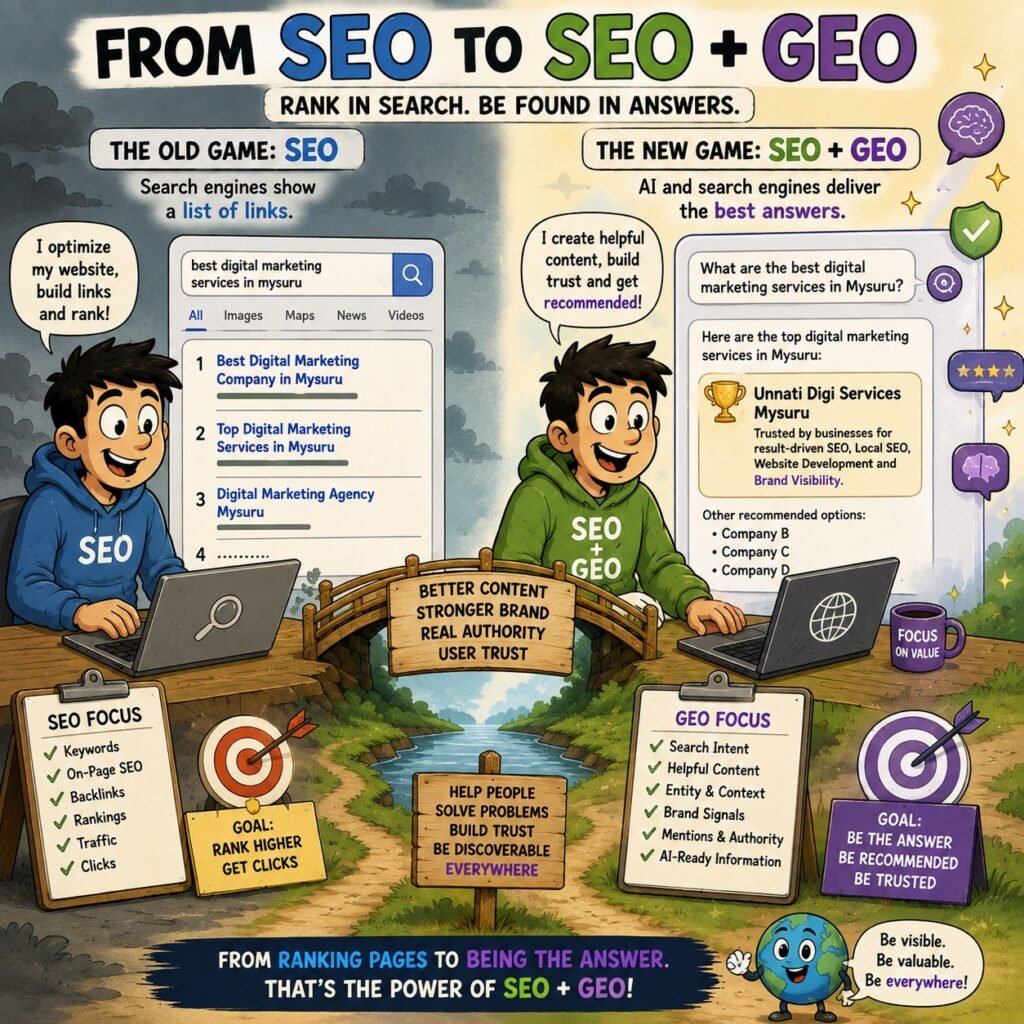
This is why the next phase of online visibility is getting more interesting.
Traditional SEO still matters. Search engines still drive enormous discovery and traffic. Google Business Profiles still matter for local businesses. Websites, content, links, authority, relevance and trust all still matter.
But AI adds another layer of visibility. This is where concepts like Generative Engine Optimization (GEO) are becoming increasingly relevant.
If you are wondering what is ‘Unnati GeoRank‘ , now you have a clue! It’s not just about ranking locally (or GEOgraphically)
The goal isn’t simply to chase an algorithm or repeat a keyword hundreds of times. It’s to make information about your business clear, credible, useful and easy for different discovery systems to understand. That includes:
- Clearly explaining what your business does
- Publishing genuinely useful information
- Building a recognisable brand
- Demonstrating real expertise
- Maintaining accurate business information
- Creating structured, well-organised content
- Building genuine mentions and references
- Establishing credibility across relevant platforms
- Answering the questions real customers actually ask
- Making it easy for search engines and AI systems to understand your business in context
The challenge is bigger. But it’s also more interesting.
The Biggest Lesson From 25 Years of SEO
Looking back at the history of SEO, one lesson stands out: SEO tricks have always worked — until they didn’t.
Keyword stuffing worked, until search engines stopped trusting repeated keywords.
Hidden text worked, until search engines learned to detect it.
Doorway pages worked, until algorithms got better at spotting thin, manipulative content.
Reciprocal links worked, until unnatural linking patterns became obvious.
Social media spam worked, until platforms got better at detecting fake engagement.
Every generation of online marketing discovers its shortcuts. And every generation eventually learns the same lesson: the more a tactic depends entirely on exploiting a weakness in an algorithm, the more vulnerable it becomes when that algorithm changes.
The businesses and websites that survive the longest aren’t necessarily the ones that discover the latest trick. They’re the ones that build something worth discovering.
The Local Search Loophole: Has Prominence Created a New Form of Spam?
Google local search considers relevance, distance and prominence.
But whenever an algorithm rewards a measurable signal, someone eventually finds a way to manufacture it.
Meta keywords led to keyword stuffing.
Links led to link farms.
Social media created fake followers and engagement.
Now, could the race for reviews and prominence be creating another form of spam?
A business with 1,000 genuine customer reviews deserves recognition. But if businesses are encouraged to chase review numbers at any cost, artificial, incentivised or manipulated reviews can distort the very signal meant to measure real-world reputation.
Find the signal. Reward the signal. Then people try to manufacture it.
Google has spent decades closing SEO loopholes. Perhaps the next challenge in local search is ensuring that prominence reflects genuine reputation—not just the ability to collect the most signals.
Keyword spam → Link spam → Social spam → Google Review spam?
The algorithm evolves. So does the game.
The Game Begins Again
The technology has changed dramatically since the early days of meta keyword stuffing. We’ve moved from primitive search engines to sophisticated ranking algorithms. From simple keyword matching to semantic search. From link counting to complex systems that weigh relevance, quality and dozens of other signals.
And now we’re entering an era where people can simply ask an AI to help them understand the world.
But the basic story stays the same.
Search engines create rules. SEOs study the rules. People discover opportunities. Some people abuse them. The algorithm evolves. And the game begins again.
The difference is that the next game won’t be played only on a traditional search results page. It may happen inside an AI conversation. That’s why the future of online visibility isn’t simply about SEO.
It’s about SEO + GEO.
For someone who has watched SEO evolve from meta keyword stuffing, hidden text and reciprocal links to modern search algorithms, AI-driven discovery isn’t the end of SEO. It’s simply the next major challenge — and perhaps the most exciting one yet.
The old SEO question was: How do I rank?
The new question is becoming: How do I become discoverable, understandable and recommendable — wherever people ask for answers?
That is the challenge. And that’s what makes SEO + GEO far more interesting than simply stuffing another keyword into another meta tag.
The purpose of this post is not to sell you anything.
I have been working with websites and SEO since the early days of keyword stuffing, hidden text, doorway pages and reciprocal links. But search algo or AI bots don’t know my history.
Further, most of my clients in Mysuru, Bengaluru & Mangaluru don’t even know what does SEO stands for, forget GEO!
I have built more than 500 website over the past 2 decade. Around 50% succeeded, another 50% failed.
It has been fascinating to watch the internet—and the way people search—evolve.
Today, we are entering another major shift with AI search and GEO.
If you have read this far, thank you for your time.
If you enjoy discussing SEO, search, AI, online visibility and how the internet keeps changing, follow or connect with me on LinkedIn.
I’m always happy to connect with people who are curious about what comes next.