
A few years ago, in a Facebook comment thread, I wrote something that wasn’t popular at the time: free UPI is unsustainable. Someone has to pay for the rails that move lakhs of crores every month. My suggestion was simple. Merchants should pay a small fee, starting at 0.1% on transactions above ₹2,000, rising in slabs to a maximum of 0.5%. That felt like the ceiling for keeping UPI affordable for everyone.
This month, the first half of that argument came true. Starting October 15, merchant payments through UPI above ₹2,000 will attract a merchant discount rate (MDR) of 0.4%, as announced by NPCI. The move ends the zero-MDR regime in place since 2020, which banks had long flagged as financially unsustainable.
So I should be happy. I’m not.
The problem isn’t the fee. It’s the cliff.
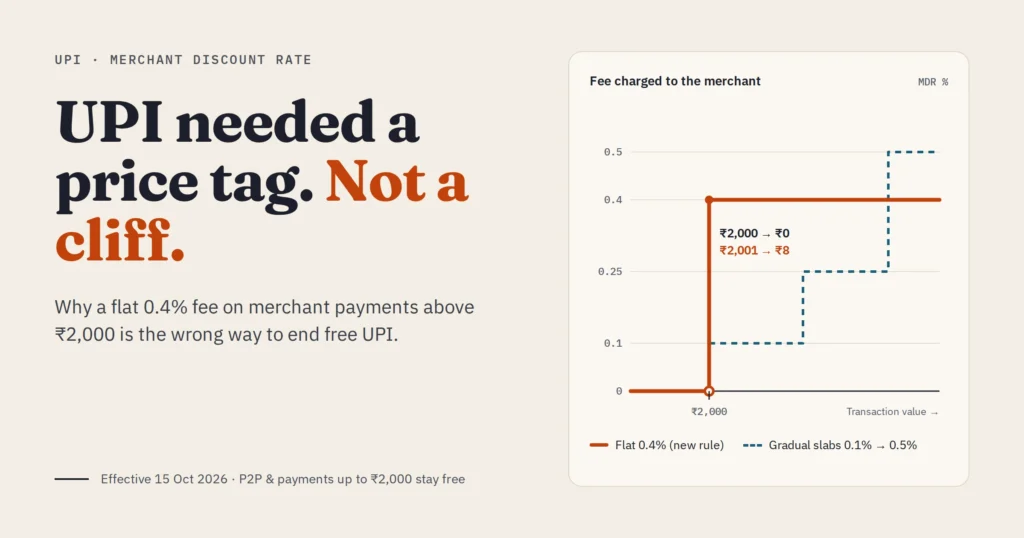
Look at what happens at the threshold. A ₹2,000 payment costs the merchant nothing. A ₹2,001 payment costs ₹8. Going from zero to 0.4% in one step creates a strange incentive: split the bill, push customers toward cash, or quietly add a “digital payment” surcharge. None of that is good for a system built on trust and convenience.
A graduated structure avoids this. Here’s the kind of model I had in mind (illustrative numbers):
| Transaction value | Suggested MDR | Fee on example |
|---|---|---|
| ₹2,001 – ₹10,000 | 0.1% | ₹5 on ₹5,000 |
| ₹10,001 – ₹50,000 | 0.25% | ₹75 on ₹30,000 |
| Above ₹50,000 | 0.5% (capped) | — |
Under the new flat rate, that ₹5,000 sale costs ₹20 instead of ₹5. For a kirana store or small pharmacy running on 8–10% margins, that difference is real.
What the government got right
To be fair, the framework has guardrails. The MDR is capped at ₹300 per transaction for payments of ₹75,000 and above. Person-to-person transfers, merchant payments up to ₹2,000, and payments to small merchants remain exempt. This includes street vendors receiving up to ₹1 lakh per month through UPI QR codes. Essential, thin-margin sectors like fuel pay a flat ₹5 above the threshold. businesstoday
That fuel exception tells me the policymakers already understand the core point: a flat 0.4% doesn’t suit every business. Why stop at one sector?
The mid-sized merchant is caught in the middle
The people I worry about are shops too big for the small-merchant exemption and too small to absorb costs easily. Think of electronics dealers, clinics, hardware stores, and local restaurants that handle many ₹2,500–₹10,000 bills. The government and IBA are reportedly working on a mechanism to ensure the charge isn’t passed on to consumers, but for a small business, costs have to land somewhere.
My ask
Keep the fee. UPI needs a sustainable business model, and I’ve said that for years. But introduce it gently: start at 0.1%, slab upward, and let merchants and the ecosystem adjust. UPI became a global success story because it was frictionless. Its pricing should be too.
Do you think a slab-based MDR would work better? I’d love to hear from merchants especially.