
Thirty years of trust, and an empty petrol tank
A cloth shop owner in a small Indian town spent more than three decades building his business. Much of it ran on credit: he let daily-wage workers take clothes home and pay later, and they did. That trust paid for his son’s engineering degree. Today the son works for a multinational company.
The son gifted his father a car while going abroad. The father drives it to the shop every morning. On some days, the shop doesn’t earn enough to fill the tank.
He owns the building, and a few rooms are rented out. One tenant runs a small refreshment stall. E-commerce delivery riders stop there for tea, then walk over to ask the shopkeeper for directions to addresses they can’t find. He helps them. Then he watches them deliver clothes his customers’ children ordered online.
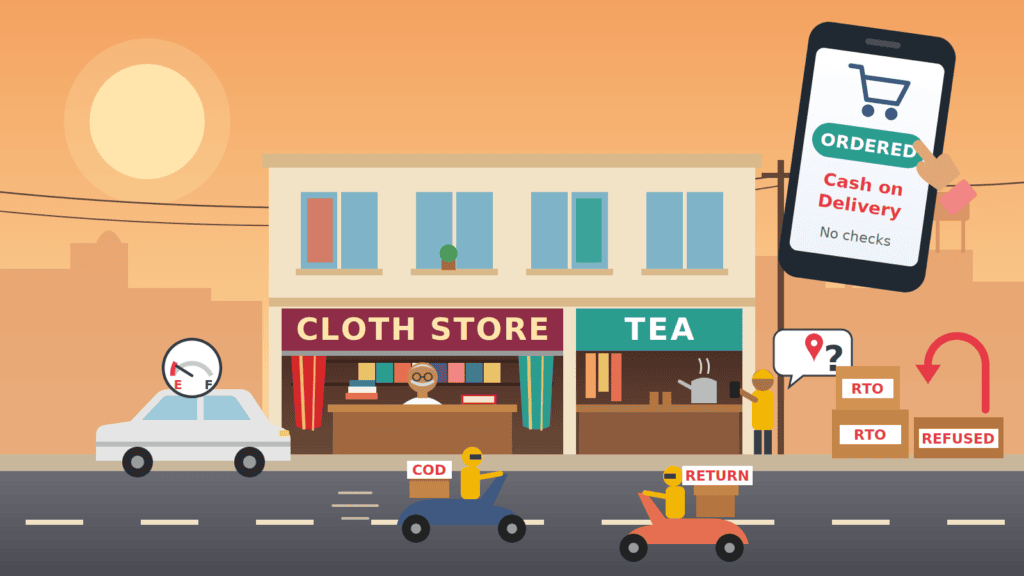
A few loyal customers still buy from him. Their children mostly don’t. This story is repeating across thousands of small towns, and aggressive cash-on-delivery (COD) e-commerce is a big part of why.
The squeeze has reached small towns
Small retailers are fighting a price war they cannot win. Platforms can spend heavily on discounts, cashback and push notifications. A local shop has none of those tools. An analysis of a Business Standard editorial notes that kiranas simply can’t match that marketing firepower [1].
The impact is no longer limited to metros. The trader body AICPDF has claimed that about 200,000 kirana stores closed in a year, including around 50,000 in Tier-II and Tier-III cities [2]. Zepto disputes those numbers. But shop owners don’t need a survey to feel the drop in footfall.
Online sellers are squeezed too. Complaints about deep discounting and favoured sellers on big marketplaces have been before the Competition Commission of India for years. As of July 2026, the CCI had still not issued a final order in a key case [3].
The COD trap
In villages and small towns, cash on delivery is how e-commerce wins customers. It is also where it breaks down. Placing a COD order costs the buyer nothing, and platforms rarely check whether an order is genuine.
The result is easy to see at home. Children browse on a parent’s phone and tap “order”. Nobody asks. A parcel arrives a few days later, and the parent refuses it. Other orders fail for ordinary reasons: the buyer changed their mind, found the item cheaper locally, or had no cash that day.
Industry benchmarks show how large this gets. One logistics analysis estimates that Tier-3 and rural areas see return-to-origin (RTO) rates of 38-50%, with first-attempt delivery success as low as 45-58% [4]. In plain words, close to half of some rural COD parcels travel out and come straight back.
COD can’t simply be switched off. About 70% of small-town shoppers prefer it [5], and for many families without UPI or cards, it is the only way they buy online.
Who really pays
The platform still records the order. The cost of failure lands on everyone else.
- Small online sellers lose the forward shipping cost, may pay return charges, and often don’t recover fees. Exact rules vary by platform and change often, but sellers have long complained of paying commission even on cancelled orders [6]. Stock is locked in transit for one to two weeks and sometimes comes back damaged. One vendor estimates that a 30% RTO rate wipes out about 12% of total revenue [7].
- Delivery riders make trips that earn nothing, hunting for addresses that exist only as a name and a landmark.
- Local shops lose customers to “free trial at home” with no commitment, a standard no shop can match.
- Families get parcels nobody ordered on purpose, and a quiet habit of impulse buying.
What the local shop still has
Go back to the delivery riders asking the shopkeeper for directions. That moment says something important. The platforms have the money, the apps and the algorithms. The shopkeeper has the one thing they lack: he knows the town.
He has other advantages too.
- Trust built over decades. Thirty years of giving credit means he knows which families are reliable, who has a wedding coming, and who shops at festival time. Even Blinkit’s CEO has acknowledged that the kirana’s personal credit system is something quick commerce can’t replicate [8].
- Try before you buy, with no failed deliveries. Customers touch the fabric, check the fit and get alterations on the spot. Nothing comes back.
- Bulk and occasion buying. Weddings, school uniforms and festival shopping still favour someone who can advise, adjust and offer credit.
The children of his loyal customers haven’t rejected his shop. They just never see it, because it doesn’t appear on the screen where they look for everything.
The shop that built an engineer deserves a future
The cloth shop in this story paid for an engineering degree. It kept families clothed on credit when no bank would lend to them. It still guides delivery riders through lanes that no map understands.
E-commerce is here to stay, and it brings real choice to small towns. But a model that pushes unverified COD orders at any cost is wasteful for sellers, riders, families and local shops alike. The answer isn’t to fight technology. It is to put simple, affordable technology in the hands of the people who already hold the town’s trust.
If you run a small shop, or have a parent or relative who does, we’d like to hear what’s hurting most.
Table of Contents
Sources
- Drishti IAS, “India’s Quick Commerce Boom” (based on a Business Standard editorial): Read more
- Retail4Growth, “Zepto says QC not impacting kiranas, but what’s the real scenario?”: Read more
- FoxMandal, “Seller body files complaint against Flipkart with CCI”: Read more
- Base, “India Ecommerce Benchmarks 2026”: Read more
- Base, “D2C Ecommerce in India 2026: 50+ Stats”: Read more
- Inc42, “An Open Letter From A Seller Who Sells On All The Major Ecommerce Marketplaces”: Read more
- eGrow, “The Complete Guide to Reducing RTO in COD E-commerce (2026)”: Read more
- Outlook Business, “Quick Commerce Not Eating into Kirana Share, Says Zomato CEO Deepinder Goyal”: Read more
RTO and COD figures come mostly from logistics and e-commerce vendors and should be read as indicative, not exact.